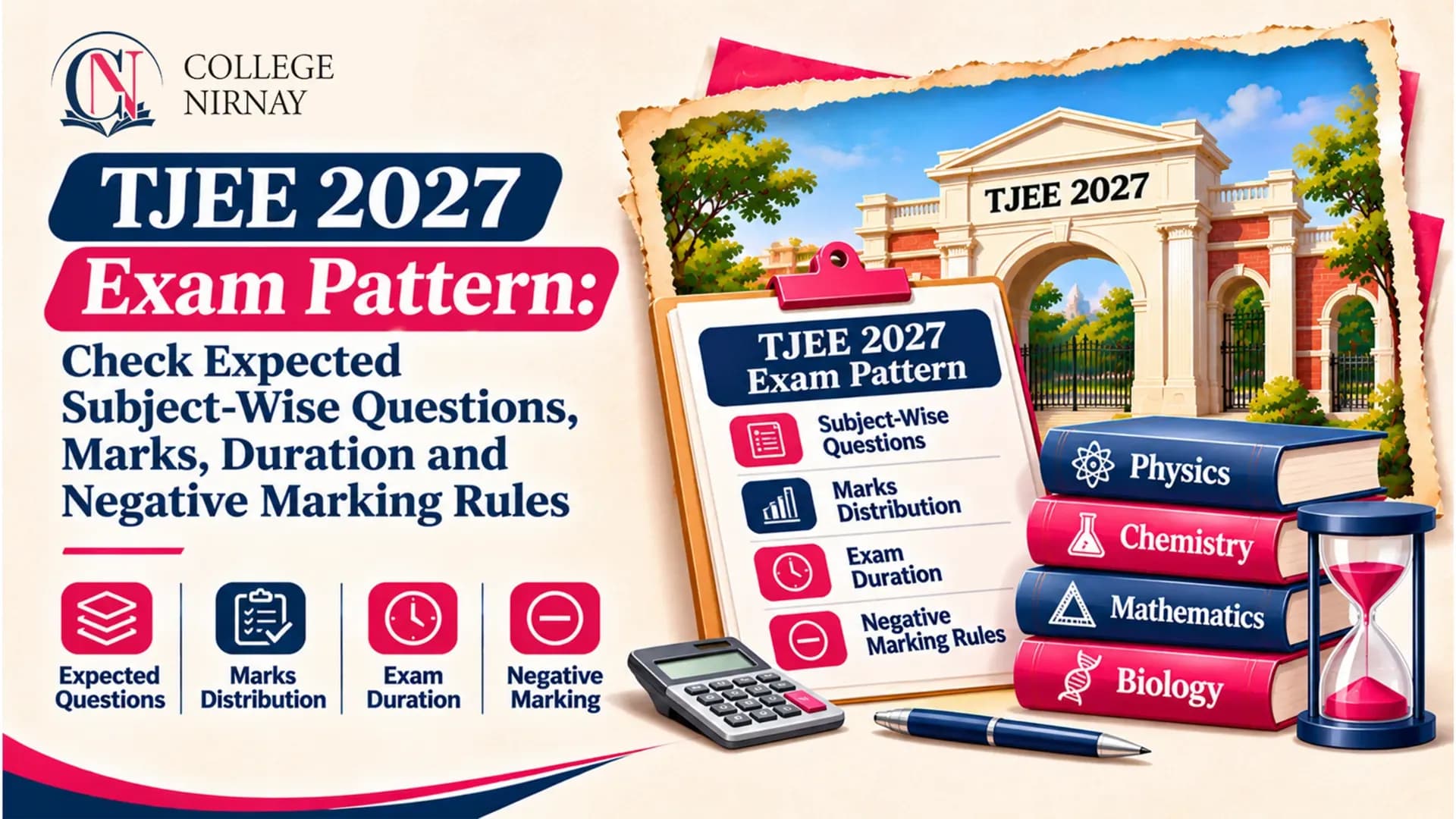
TJEE 2027 Exam Pattern: Check Expected Subject-Wise Questions, Marks, Duration and Negative Marking Rules
TJEE 2027 exam pattern: The Tripura Board of Joint Entrance Examination (TBJEE) is expected to release the examination pattern for the Tripura Joint Entrance Examination 2027 through its official information prospectus. Candidates preparing for engineering, agriculture, veterinary, fisheries, technological and other notified professional degree programmes should understand the examination structure before beginning their subject-wise preparation.
Based on the previously published official examination framework, the TJEE exam pattern 2027 is expected to follow an offline, OMR-based multiple-choice question format. The examination covers four subjects, namely Physics, Chemistry, Mathematics and Biology, with candidates appearing for the subjects prescribed for their selected examination group.
The expected TJEE subject wise questions distribution includes 30 questions from each subject, carrying a maximum of 120 marks. Physics and Chemistry are conducted in a combined paper comprising 60 questions for 240 marks, while Mathematics and Biology are conducted separately.
Understanding the TJEE marking scheme 2027, examination duration, subject combinations and negative marking provisions can help candidates improve their time management and question-solving accuracy.
The TBJEE exam pattern 2027 is expected to retain the three-group examination structure, allowing students to select Group A, Group B or Group C according to their academic qualifications and preferred admission stream.
TJEE 2027 Exam Pattern Overview: Examination Mode, Questions and Maximum Marks
The Tripura Joint Entrance Examination exam pattern is designed to evaluate candidates' understanding of higher secondary-level science subjects through objective questions. The examination is conducted by TBJEE to prepare merit lists for admission to applicable professional degree programmes.
Under the historical examination structure, every subject consists of 30 multiple-choice questions. Candidates appearing for three subjects attempt 90 questions, while candidates appearing for all four subjects attempt 120 questions.
OMR-based examination
Depends on examination group
Based on selected subjects
Correct and incorrect responses
TJEE 2027 Examination Pattern Highlights
| Examination Parameter | Expected Details for 2027 |
|---|---|
| Examination Name | Tripura Joint Entrance Examination |
| Conducting Authority | Tripura Board of Joint Entrance Examination (TBJEE) |
| Academic Session | 2027–28 |
| Examination Level | State-Level Entrance Examination |
| Examination Mode | Offline, Pen-and-Paper OMR Mode |
| Question Format | Multiple-Choice Questions (MCQs) |
| Available Subjects | Physics, Chemistry, Mathematics and Biology |
| Examination Groups | Group A, Group B and Group C |
| Questions Per Subject | 30 Questions |
| Maximum Marks Per Subject | 120 Marks |
| TJEE Number of Questions | 90 for Group A/B; 120 for Group C |
| TJEE Total Marks 2027 | 360 for Group A/B; 480 across all Group C subjects |
| Marks for Correct Answer | +4 Marks |
| Negative Marking | −1 Mark for each incorrect answer |
| Question Paper Language | English and Bengali |
| Examination Duration | 135 minutes for Group A/B; 180 minutes for Group C, excluding breaks |
| Official Website | tbjee.nic.in |
TJEE Group A, Group B and Group C Exam Pattern 2027
The Tripura Joint Entrance Examination follows a group-based examination system. Candidates select their group according to their qualifying examination subjects and the professional programmes they intend to pursue.
Physics and Chemistry remain common subjects for all three examination groups, while Mathematics and Biology requirements differ according to the selected stream.
TJEE Group A Exam Pattern
PCM Stream
Group A is intended for eligible candidates seeking admission to engineering and technological degree programmes.
- Physics: 30 Questions
- Chemistry: 30 Questions
- Mathematics: 30 Questions
Total Questions: 90
Maximum Marks: 360
Writing Duration: 135 Minutes
TJEE Group B Exam Pattern
PCB Stream
Group B is intended for eligible candidates seeking admission to notified biology-based professional degree programmes.
- Physics: 30 Questions
- Chemistry: 30 Questions
- Biology: 30 Questions
Total Questions: 90
Maximum Marks: 360
Writing Duration: 135 Minutes
TJEE Group C Exam Pattern
PCMB Stream
Group C allows eligible candidates to participate in both engineering and biology-based examination streams.
- Physics: 30 Questions
- Chemistry: 30 Questions
- Mathematics: 30 Questions
- Biology: 30 Questions
Total Questions: 120
Combined Maximum Marks: 480
Writing Duration: 180 Minutes
TJEE Group-Wise Examination Pattern Comparison
| Parameter | Group A | Group B | Group C |
|---|---|---|---|
| Physics | Required | Required | Required |
| Chemistry | Required | Required | Required |
| Mathematics | Required | Not Required | Required |
| Biology | Not Required | Required | Required |
| Total Subjects | 3 | 3 | 4 |
| Total Examination Papers | 2 | 2 | 3 |
| Total Questions | 90 | 90 | 120 |
| Maximum Raw Marks | 360 | 360 | 480 |
| Writing Duration | 135 Minutes | 135 Minutes | 180 Minutes |
| Admission Stream | Engineering and Technology | Notified PCB-Based Programmes | Both Admission Streams |
TJEE Subject Wise Marks Distribution 2027: Physics, Chemistry, Mathematics and Biology
The expected subject-wise examination structure provides equal maximum marks to each science subject. Every subject contains 30 objective questions for 120 marks under the earlier examination framework.
Candidates should understand the TJEE subject wise marks distribution before preparing a study timetable. Equal subject-level marks mean students should avoid completely neglecting any subject required for their examination group.
| Subject | Questions | Marks Per Question | Maximum Marks | Syllabus Modules |
|---|---|---|---|---|
| Physics | 30 | 4 | 120 | 10 |
| Chemistry | 30 | 4 | 120 | 10 |
| Mathematics | 30 | 4 | 120 | 10 |
| Biology | 30 | 4 | 120 | 10 |
| All Four Subjects | 120 | 4 | 480 | 40 |
Subject-Wise Examination Pattern and Preparation Focus
TJEE Physics Exam Pattern
Physics includes conceptual questions, numerical applications and problems based on scientific principles.
Questions: 30
Maximum Marks: 120
Paper: Combined with Chemistry
Illustrative Preparation Topics
- Units, dimensions and measurements
- Mechanics and laws of motion
- Work, energy and gravitation
- Thermodynamics
- Oscillations and waves
- Electrostatics and current electricity
- Magnetism and electromagnetic induction
- Optics and modern physics
TJEE Chemistry Exam Pattern
Chemistry preparation should include relevant physical, organic and inorganic chemistry concepts prescribed in the official syllabus.
Questions: 30
Maximum Marks: 120
Paper: Combined with Physics
Illustrative Preparation Topics
- Basic chemical calculations
- Atomic structure and periodicity
- Chemical bonding
- Thermodynamics and equilibrium
- Solutions and electrochemistry
- Chemical kinetics
- Organic chemistry fundamentals
- Inorganic chemistry concepts
TJEE Mathematics Exam Pattern
Mathematics tests quantitative reasoning, formula application, mathematical accuracy and problem-solving ability.
Questions: 30
Maximum Marks: 120
Duration: 45 Minutes
Illustrative Preparation Topics
- Sets, relations and functions
- Algebra and complex numbers
- Sequences and series
- Trigonometry
- Coordinate geometry
- Differentiation and integration
- Matrices and determinants
- Vectors, probability and statistics
TJEE Biology Exam Pattern
Biology evaluates understanding of living organisms, biological processes, classification and relevant higher secondary scientific concepts.
Questions: 30
Maximum Marks: 120
Duration: 45 Minutes
Illustrative Preparation Topics
- Diversity of living organisms
- Cell structure and function
- Plant physiology
- Human physiology
- Reproduction
- Genetics and evolution
- Biotechnology
- Ecology and environment
Expected Subject-Wise Weightage for Group A and Group B
Each of the three relevant subjects contributes one-third of the maximum raw marks under the historical framework.
Physics — 120 Marks (33.33%)
Chemistry — 120 Marks (33.33%)
Mathematics or Biology — 120 Marks (33.33%)
TJEE MCQ Pattern 2027: Question Types, Answer Options and Module-Wise Distribution
The expected TJEE question paper pattern follows an objective assessment system. Each question provides four answer options, from which candidates must identify the appropriate answer and mark the corresponding response on the OMR answer sheet.
The official historical question framework divides each subject syllabus into 10 modules, with questions distributed equally across those modules.
Expected Module-Wise Question Distribution for Each Subject
| Syllabus Module | Questions | Maximum Marks | Subject Weightage |
|---|---|---|---|
| Module 1 | 3 | 12 | 10% |
| Module 2 | 3 | 12 | 10% |
| Module 3 | 3 | 12 | 10% |
| Module 4 | 3 | 12 | 10% |
| Module 5 | 3 | 12 | 10% |
| Module 6 | 3 | 12 | 10% |
| Module 7 | 3 | 12 | 10% |
| Module 8 | 3 | 12 | 10% |
| Module 9 | 3 | 12 | 10% |
| Module 10 | 3 | 12 | 10% |
| Total | 30 | 120 | 100% |
Expected Features of TJEE Multiple-Choice Questions
Four Answer Options
Candidates choose the appropriate response from options A, B, C and D.
Single Answer Selection
Only one response should be marked against an individual question.
Objective Evaluation
Responses are evaluated using the applicable OMR-based assessment process.
Syllabus-Based Coverage
Questions are prepared using the prescribed TBJEE subject modules.
Sample MCQ Format for TJEE 2027 Preparation
Which of the following represents the SI unit of force?
This is an illustrative practice question and not a confirmed TJEE 2027 examination question.
TJEE Marking Scheme 2027: Correct Answers, Incorrect Responses and Negative Marking Rules
The historical examination pattern awards four marks for a correct response and deducts one mark for an incorrect answer. Candidates preparing for TJEE should therefore balance question-solving speed with accuracy.
Understanding the TJEE negative marking rules is particularly important for students who tend to attempt questions without sufficient conceptual understanding or careful option elimination.
Four marks awarded
One mark deducted
No marks awarded
Expected TJEE Negative Marking Rules and Response Evaluation
| Response Type | Expected Marks | Explanation |
|---|---|---|
| Correct Single Response | +4 | Full marks for the correct option |
| Incorrect Single Response | −1 | One mark deducted |
| Unattempted Question | 0 | No score for an unanswered question |
| Multiple Options Marked | 0 under earlier OMR rules | Multiple responses are not accepted for evaluation |
| Altered Response | 0 under earlier OMR rules | Changes to an already marked response are not permitted |
How to Calculate Expected TJEE 2027 Raw Marks
Expected Raw Score Calculation Formula
Unattempted questions contribute zero marks.
TJEE Score Calculation Example
Suppose a candidate appears for a 30-question Mathematics examination and records the following responses:
| Response Category | Questions | Calculation | Marks |
|---|---|---|---|
| Correct Answers | 24 | 24 × 4 | 96 |
| Incorrect Answers | 4 | 4 × −1 | −4 |
| Unattempted Questions | 2 | 2 × 0 | 0 |
| Final Raw Score | 30 | 96 − 4 | 92 / 120 |
Sample Group-Wise Score Calculations
| Scenario | Correct | Incorrect | Unattempted | Raw Score |
|---|---|---|---|---|
| Group A/B Example 1 | 80 | 5 | 5 | 315/360 |
| Group A/B Example 2 | 70 | 10 | 10 | 270/360 |
| Group A/B Example 3 | 60 | 20 | 10 | 220/360 |
| Group C Combined Example 1 | 100 | 10 | 10 | 390/480 |
| Group C Combined Example 2 | 90 | 15 | 15 | 345/480 |
How to Reduce Negative Marking in TJEE 2027
- Read every question and answer option carefully.
- Complete familiar and straightforward questions first.
- Avoid careless calculation errors in numerical questions.
- Use logical elimination when uncertain about an answer.
- Consider the risk of losing marks before attempting unfamiliar questions.
- Check that the selected answer corresponds to the correct OMR question number.
- Practise mock examinations using the expected positive and negative marking system.
- Analyse incorrect responses after every practice test.
TJEE Exam Duration 2027: Combined Physics-Chemistry Paper and Subject-Wise Examination Timings
The expected examination duration depends on the selected group. Physics and Chemistry are conducted together within a 90-minute examination period, while Mathematics and Biology each have a separate 45-minute examination period.
Candidates appearing under Group A or Group B therefore have a combined writing duration of 135 minutes. Candidates registered under Group C appear for all three examination sessions, with a combined writing duration of 180 minutes.
Physics and Chemistry
60 Questions | 240 Marks
Biology
30 Questions | 120 Marks
Mathematics
30 Questions | 120 Marks
Expected TJEE Examination Shift Structure
| Examination Session | Subject | Duration | Applicable Groups |
|---|---|---|---|
| First Session | Physics and Chemistry | 90 Minutes | Group A, B and C |
| Second Session | Biology | 45 Minutes | Group B and C |
| Third Session | Mathematics | 45 Minutes | Group A and C |
The above shift order follows the historical examination framework. The exact 2027 shift timings, reporting schedule and examination date must be checked in the official notification and admit card.
Average Time Available Per Question
Average Time Per Question
90 Minutes ÷ 60 Questions = 1.5 Minutes Per Question
Suggested Time Management for Physics and Chemistry
| Activity | Suggested Time | Preparation Approach |
|---|---|---|
| Physics Questions | 40 Minutes | Balance conceptual and numerical questions |
| Chemistry Questions | 35 Minutes | Complete familiar reaction-based and conceptual questions |
| Remaining Questions | 10 Minutes | Return to unresolved questions |
| Final OMR Verification | 5 Minutes | Verify required identification and response alignment |
| Total | 90 Minutes | Combined Paper |
Suggested Time Management for Mathematics or Biology
| Activity | Suggested Duration |
|---|---|
| Initial Question Reading | 3 Minutes |
| Primary Question Attempts | 30 Minutes |
| Remaining Questions | 8 Minutes |
| Final Verification | 4 Minutes |
| Total | 45 Minutes |
Will the TJEE Exam Pattern 2027 Change? Expected Examination Rules and OMR Guidelines
Candidates preparing for TJEE 2027 should continue following the established examination structure until TBJEE publishes revised instructions, if any.
The board introduced a single-day examination structure from the 2021 examination cycle. The later historical framework continued with combined Physics and Chemistry assessment and separate Biology and Mathematics sessions.
Historical Examination Pattern and Expected 2027 Continuation
| Examination Feature | Official 2025 Framework | Expected 2027 Framework |
|---|---|---|
| Examination Mode | Offline OMR | Expected to Continue |
| Examination Structure | Single Day | Expected to Continue |
| Question Type | MCQs | Expected to Continue |
| Modules Per Subject | 10 | Subject to Confirmation |
| Questions Per Subject | 30 | 30 Expected |
| Positive Marking | +4 | +4 Expected |
| Negative Marking | −1 | −1 Expected |
| Question Paper Languages | English and Bengali | Expected to Continue |
| Physics-Chemistry Duration | 90 Minutes | 90 Minutes Expected |
| Mathematics/Biology Duration | 45 Minutes Each | 45 Minutes Each Expected |
Expected OMR Answer Sheet Instructions for TJEE 2027
Candidates must understand the correct OMR response-marking method because improper bubbling, incorrect identification information or damage to the answer sheet may affect evaluation.
1. Verify Candidate Information
Enter the roll number and other required identification information in the prescribed fields.
2. Check Question Booklet Series
Ensure that the booklet series recorded on the answer sheet matches the question paper provided.
3. Mark Only One Option
Darken only the selected answer circle corresponding to the question being attempted.
4. Avoid Changing Marked Responses
Under earlier rules, erasing or modifying an already marked response was not permitted.
5. Use the Prescribed Writing Instrument
Follow the pen type and ink colour requirements stated in the official examination instructions.
6. Protect the OMR Answer Sheet
Avoid folding, tearing or adding unrelated markings to the answer sheet.
Illustrative OMR Response Marking Examples
Correct Marking Method — One Filled Option
Only option B is selected.
Incorrect Marking Method — Multiple Filled Options
Multiple responses are not accepted under the earlier evaluation rules.
Common Examination Mistakes Candidates Should Avoid
Skipping Entire Syllabus Modules
The historical question distribution gives equal representation to every subject module. Leaving entire modules unprepared can reduce scoring opportunities.
Ignoring Negative Marking
Incorrect answers reduce the overall raw score. Candidates should consider accuracy while deciding whether to attempt uncertain questions.
Spending Too Much Time on One Question
Lengthy calculations can consume valuable examination time and reduce opportunities to complete easier questions.
Incorrect OMR Question Alignment
Marking an answer against the wrong question number can lead to unintended incorrect responses.
Neglecting Combined Paper Practice
Students should practise Physics and Chemistry together within the expected 90-minute time limit.
Relying on Unconfirmed Examination Changes
Students should follow official TBJEE announcements instead of treating unofficial predictions as confirmed rules.
Complete TJEE 2027 Exam Pattern Table and Subject-Wise Preparation Strategy
Students should prepare according to their selected examination group and develop a consistent study routine covering theory, numerical practice, module-wise revision and timed mock examinations.
| Paper | Subjects | Questions | Marks | Duration | Applicable Groups |
|---|---|---|---|---|---|
| Combined Paper | Physics and Chemistry | 60 | 240 | 90 Minutes | A, B and C |
| Biology Paper | Biology | 30 | 120 | 45 Minutes | B and C |
| Mathematics Paper | Mathematics | 30 | 120 | 45 Minutes | A and C |
| All Papers | PCMB | 120 | 480 | 180 Minutes | Group C |
120-Day Preparation Roadmap for TJEE 2027
Days 1–40: Conceptual Foundation
Study the prescribed subject modules, strengthen core concepts, prepare formula sheets and practise basic objective questions. Give sufficient attention to both Class 11 and Class 12 topics included in the official syllabus.
Days 41–75: Module-Wise Completion
Complete remaining syllabus modules, solve chapter-based MCQs and revise weak areas. Attempt short 30-question subject tests regularly.
Days 76–100: Previous Papers and Mock Tests
Practise available previous-year papers, combined Physics-Chemistry tests and separate Mathematics or Biology papers within the expected duration. Analyse every incorrect answer.
Days 101–120: Final Revision and Examination Simulation
Revise formulas, reactions, diagrams and frequently misunderstood concepts. Practise complete group-wise examination simulations and develop familiarity with OMR response marking.
Suggested Daily Study Plan According to Examination Group
| Study Activity | Group A | Group B | Group C |
|---|---|---|---|
| Physics | 90 Minutes | 90 Minutes | 75 Minutes |
| Chemistry | 75 Minutes | 75 Minutes | 75 Minutes |
| Mathematics | 90 Minutes | Not Applicable | 75 Minutes |
| Biology | Not Applicable | 90 Minutes | 75 Minutes |
| MCQ Practice and Revision | 45 Minutes | 45 Minutes | 60 Minutes |
| Suggested Total | 5 Hours | 5 Hours | 6 Hours |
This is an illustrative self-study timetable. Students should adjust the duration according to school commitments, preparation level, rest requirements and individual learning needs.
Weekly Mock Test Preparation Strategy
Physics-Chemistry Mock
Questions: 60
Duration: 90 Minutes
Practise managing both subjects within one examination session.
Mathematics Mock
Questions: 30
Duration: 45 Minutes
Improve numerical speed, formula application and accuracy.
Biology Mock
Questions: 30
Duration: 45 Minutes
Strengthen conceptual understanding, terminology and recall.
TJEE 2027 Preparation Checklist
Frequently Asked Questions About TJEE 2027 Exam Pattern
1. What is the expected TJEE 2027 exam pattern?
The examination is expected to follow an offline OMR-based objective format covering Physics, Chemistry, Mathematics and Biology according to the selected examination group. The final pattern is subject to official confirmation.
2. How many questions are expected in TJEE 2027?
The expected TJEE number of questions is 90 for Group A and Group B candidates and 120 for Group C candidates, based on the earlier examination framework.
3. What are the expected TJEE total marks 2027?
The maximum raw marks are expected to be 360 for Group A and Group B and 480 across all four subjects for Group C.
4. Is TJEE conducted online or offline?
The previous examination framework used an offline pen-and-paper OMR system. Continuation of this examination mode is expected for 2027, subject to official confirmation.
5. What is the expected TJEE exam duration?
The writing duration is expected to be two hours and 15 minutes for Group A and Group B and three hours for Group C, excluding examination breaks and reporting periods.
6. Is there negative marking in TJEE 2027?
Under the historical marking framework, one mark is deducted for an incorrect answer, while a correct answer receives four marks. Candidates should verify the final 2027 rules.
7. How many marks are awarded for every correct answer?
Each correct response carried four marks under the previously published official pattern.
8. Are marks deducted for unattempted questions?
Unattempted questions ordinarily contribute zero marks, while the negative marking penalty applies to incorrect responses.
9. What is the expected TJEE Physics exam pattern?
Physics is expected to contain 30 questions carrying 120 marks and will be conducted within the combined Physics-Chemistry examination period.
10. What is the expected TJEE Chemistry exam pattern?
Chemistry is expected to contain 30 questions carrying 120 marks. Together, Physics and Chemistry form a 60-question examination worth 240 marks.
11. What is the expected TJEE Mathematics exam pattern?
The Mathematics paper is expected to include 30 objective questions for 120 marks, with a duration of 45 minutes.
12. What is the expected TJEE Biology exam pattern?
The Biology paper is expected to contain 30 multiple-choice questions carrying 120 marks, to be completed within 45 minutes.
13. What is the TJEE Group A exam pattern?
Group A includes Physics, Chemistry and Mathematics. Under the earlier examination structure, candidates attempt 90 questions carrying a maximum of 360 marks.
14. What is the TJEE Group B exam pattern?
Group B includes Physics, Chemistry and Biology, comprising an expected 90 questions for 360 marks.
15. What is the TJEE Group C exam pattern?
Group C includes all four subjects, with an expected total of 120 questions and 480 combined maximum raw marks across the subject examinations.
16. Are Physics and Chemistry conducted separately?
Under the historical examination structure, Physics and Chemistry are conducted together in a combined 90-minute examination.
17. How many syllabus modules are included in each TJEE subject?
The historical TBJEE framework divides each subject syllabus into 10 modules. Candidates should verify the applicable 2027 syllabus structure once released.
18. What is the TJEE subject wise questions distribution across modules?
Under the earlier framework, each of the 10 modules contributes three questions, resulting in 30 questions per subject.
19. Does every subject module have equal marks?
Under the historical pattern, each module contributes three four-mark questions, representing 12 marks or 10% of the subject's maximum raw marks.
20. Is the TJEE MCQ pattern based on four answer choices?
Yes. The previous objective examination format provided four options for every question, requiring candidates to select one appropriate response.
21. What happens if two answers are marked for one question?
According to earlier OMR instructions, multiple responses against a question were not accepted for evaluation and resulted in zero marks for that question.
22. Can candidates erase an answer on the OMR sheet?
The earlier examination rules prohibited alteration of marked responses and the use of erasers, correction fluids or similar methods on the OMR sheet.
23. In which languages is the TJEE question paper available?
The historical examination framework provided questions in English and Bengali. The final 2027 language provisions must be verified in the prospectus.
24. Is Mathematics compulsory for every TJEE candidate?
No. Mathematics is required for Group A and Group C candidates. Group B candidates appear for Physics, Chemistry and Biology.
25. Is Biology compulsory for Group A candidates?
No. Group A follows the PCM subject combination. Biology is required for Group B and Group C.
26. Does TJEE have descriptive or long-answer questions?
The historical TJEE question paper pattern consists of objective multiple-choice questions rather than descriptive written answers.
27. How can candidates calculate their expected TJEE scores?
Under the earlier marking scheme, multiply the number of correct responses by four and subtract the number of incorrect answers to estimate the raw score.
28. Is the Group C merit score calculated out of 480 marks?
The 480-mark figure represents the combined maximum raw marks across four subjects. Merit calculations for the PCM and PCB streams depend on the relevant subject combinations and officially notified ranking rules.
29. How much time is available per TJEE question?
Based on 30 questions within 45 minutes, or 60 questions within 90 minutes, candidates have an average of 90 seconds per question.
30. Is the official TBJEE exam pattern 2027 confirmed?
The final 2027 examination pattern has not been independently confirmed. Candidates should consult the official prospectus after its publication.
31. Should candidates practise previous-year TJEE question papers?
Yes. Available previous papers can help students understand question formats, topic coverage, time management requirements and common examination challenges.
32. Is there a fixed Class 11 and Class 12 examination weightage?
The historical framework specifies module-wise question distribution. Candidates should not assume a fixed percentage for Class 11 and Class 12 separately unless the board publishes such a division.
33. Does the board publish percentile scores along with ranks?
The official 2025 prospectus indicated that percentile scores would accompany ranks in the result publication. Candidates should verify the applicable 2027 result and merit preparation rules.
34. Can candidates use calculators during the TJEE examination?
Candidates should not bring or use calculators unless explicitly permitted by the official examination instructions. Regular numerical practice without electronic calculation devices is advisable.
35. Where can candidates check the official TJEE examination pattern?
Candidates should visit tbjee.nic.in to access the official prospectus, syllabus, question-pattern instructions and examination-related notifications.
Conclusion: Prepare According to the Expected TJEE Examination Structure
The Tripura Joint Entrance Examination exam pattern is expected to retain the objective, offline and group-based examination framework used in earlier examination cycles. Each subject is expected to carry 120 marks through 30 multiple-choice questions.
Candidates preparing for engineering admission should concentrate on Physics, Chemistry and Mathematics, while biology-based professional programme aspirants should focus on Physics, Chemistry and Biology. Eligible candidates seeking opportunities in both admission streams should prepare all four subjects.
The historical pattern of awarding four marks for correct answers and deducting one mark for incorrect responses makes accuracy an important component of examination preparation. Regular module-wise practice, timed mock tests and OMR familiarity can help students improve their overall performance.
Students should continue their preparation using the previously published examination framework while monitoring the official TBJEE website for the final 2027 examination pattern, syllabus, examination timings and evaluation instructions.
Official Examination References
Conducting Authority: Tripura Board of Joint Entrance Examination (TBJEE)
Official Website: Visit TBJEE Official Website
Historical Examination Prospectus: Official TJEE 2025 Prospectus
Historical Syllabus and Question Pattern: Official TJEE 2025 Syllabus and Question Pattern Guidelines
These documents are historical references for the expected examination structure. The final 2027 prospectus and subsequent official notifications will govern the upcoming examination.
Important College Nirnay TJEE Exam Pattern Links
- TJEE 2027 Exam Pattern – Complete Guide
- TJEE Exam Pattern Overview and Examination Highlights
- TJEE Group A, Group B and Group C Examination Papers
- TJEE Subject-Wise Question Distribution and Maximum Marks
- TJEE Question Format and Multiple-Choice Examination Structure
- TJEE Marking Scheme 2027 and Negative Marking Rules
- TJEE Examination Duration and Shift-Wise Timings
- TJEE Expected Examination Pattern Changes
- TJEE Complete Examination Pattern Comparison Table
- TJEE Examination Pattern Frequently Asked Questions