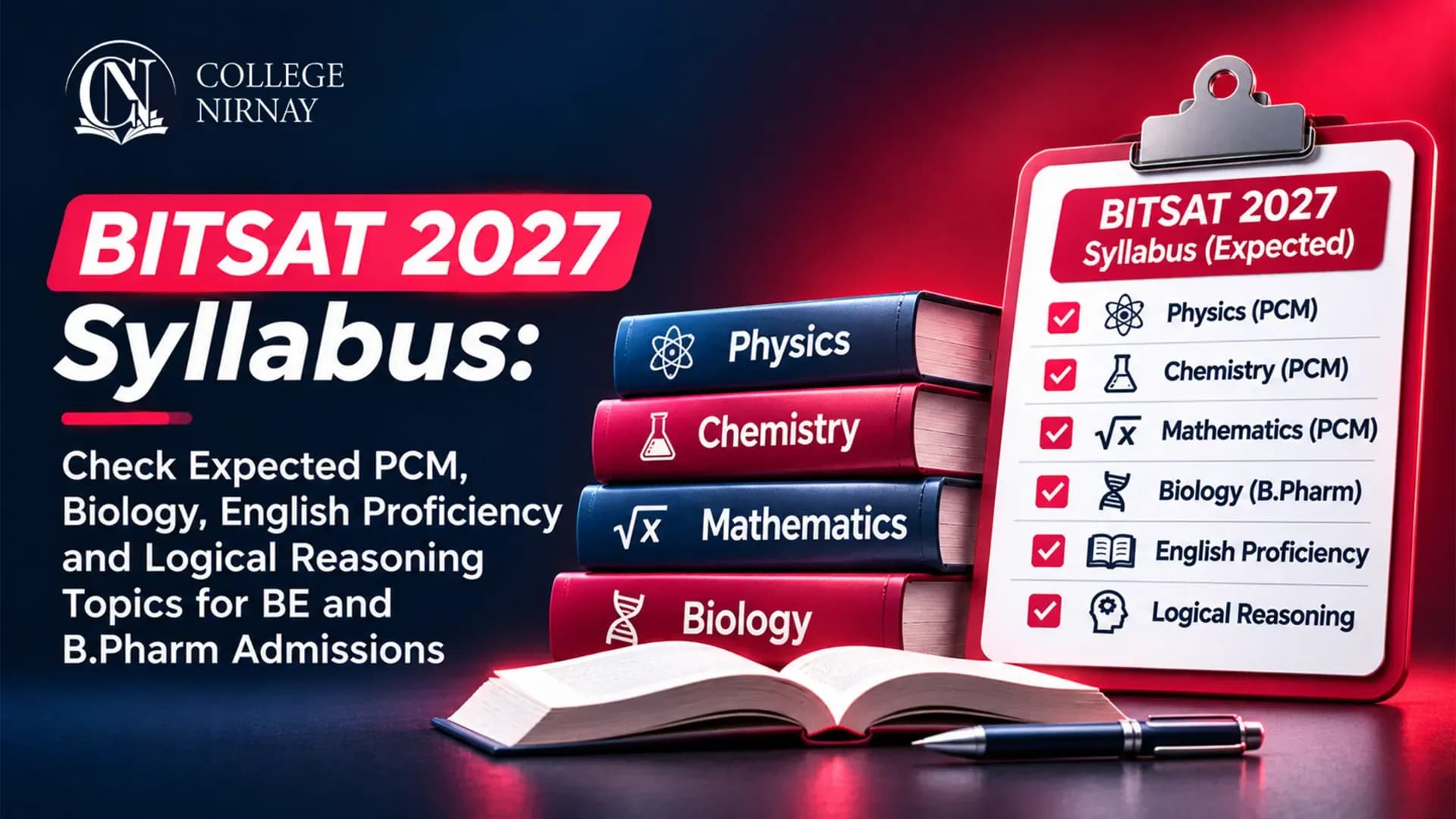
BITSAT 2027 Syllabus: Check Expected PCM, Biology, English Proficiency and Logical Reasoning Topics for BE and B.Pharm Admissions
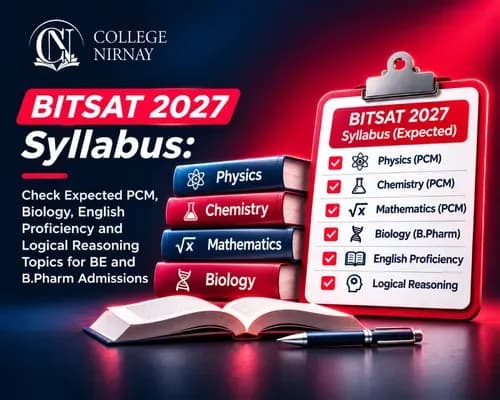
The BITSAT 2027 syllabus is expected to cover Physics, Chemistry, Mathematics or Biology, English Proficiency and Logical Reasoning. Candidates seeking admission to Bachelor of Engineering (BE) and Bachelor of Pharmacy (B.Pharm) programmes at BITS Pilani can begin preparing using the previous examination syllabus while awaiting the official 2027 information brochure.
The BITSAT syllabus 2027 is expected to follow the senior secondary academic framework, including concepts studied in Classes 11 and 12. Unlike several conventional engineering entrance examinations, BITSAT also assesses English language proficiency, analytical ability and logical reasoning alongside core science subjects.
Students preparing for the upcoming admission cycle can explore the detailed BITSAT subject wise syllabus to understand the expected examination coverage, important preparation areas and programme-specific subject combinations.
The BITSAT expected syllabus will help candidates develop a structured study plan. Engineering aspirants should primarily prepare Physics, Chemistry and Mathematics, while eligible Pharmacy applicants may prepare Biology or Mathematics according to their selected examination pathway.
Latest Update – November 28, 2026
The official BITSAT syllabus PDF 2027 could not yet be confirmed. The following syllabus guide is based on the previous examination framework and indicative preparation topics. Candidates must verify the final chapter list, programme eligibility and examination requirements once BITS Pilani publishes the official 2027 admission brochure.
BITSAT 2027 Syllabus Overview
The BITSAT 2027 syllabus overview provides an understanding of the subjects, examination sections and academic requirements associated with the entrance test conducted by Birla Institute of Technology and Science, Pilani.
The BITS Pilani entrance exam syllabus is designed to evaluate conceptual understanding, application of scientific principles, numerical problem-solving skills, communication ability and analytical reasoning.
The BITSAT Class 11 syllabus and BITSAT Class 12 syllabus together form the foundation of science and Mathematics preparation. However, students should follow the examination-specific chapter list instead of assuming that every topic included in their school curriculum will necessarily appear in BITSAT.
| Particulars | Expected BITSAT 2027 Details |
|---|---|
| Examination Name | Birla Institute of Technology and Science Admission Test |
| Conducting Authority | BITS Pilani |
| Academic Session | 2027–2028 |
| Syllabus Standard | Class 11 and Class 12 level |
| Engineering Subjects | Physics, Chemistry, Mathematics, English Proficiency and Logical Reasoning |
| Pharmacy Subjects | Physics, Chemistry, Mathematics or Biology, English Proficiency and Logical Reasoning, according to eligibility |
| Examination Mode | Computer-Based Test |
| Question Type | Single-correct-answer multiple-choice questions |
| Examination Language | English |
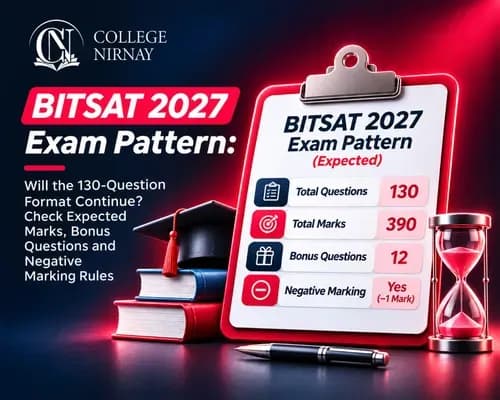
| Regular Questions | 130, if the previous format continues |
| Syllabus Release Status | Awaiting confirmation of the official 2027 brochure |
Expected Subject-Wise Question Distribution
Candidates should understand the expected question distribution before planning their BITSAT preparation topics. The following structure reflects the 2026 examination format and may continue in 2027.
| Subject | Questions | Marks | Share of Questions |
|---|---|---|---|
| Physics | 30 | 90 | 23.08% |
| Chemistry | 30 | 90 | 23.08% |
| Mathematics or Biology | 40 | 120 | 30.77% |
| English Proficiency | 10 | 30 | 7.69% |
| Logical Reasoning | 20 | 60 | 15.38% |
| Total | 130 | 390 | 100% |
Expected BITSAT Subject Distribution
Note: The percentages represent subject-level question distribution from the previous examination framework. They do not represent confirmed chapter-level weightage for BITSAT 2027.
BITSAT 2027 Subject-Wise and Chapter-Wise Syllabus
The BITSAT chapter wise syllabus includes science and Mathematics concepts studied during senior secondary education. Candidates must select their preparation subjects according to the examination pathway applicable to their desired programme.
The BITSAT PCM syllabus is particularly relevant to students seeking admission to conventional BE programmes. Meanwhile, the BITSAT Biology syllabus is relevant for students selecting the Biology pathway for eligible programmes, including B.Pharm.
BITSAT Physics Syllabus 2027
The BITSAT Physics syllabus focuses on physical principles, mathematical applications, measurement techniques and numerical problem-solving. Candidates should develop a strong understanding of mechanics, electricity, magnetism, optics and modern Physics.
| Chapter / Unit | Expected Preparation Topics |
|---|---|
| Units and Measurements | Measurement systems, dimensional methods, significant digits, measuring instruments and experimental accuracy. |
| Kinematics | Vector quantities, motion graphs, projectile trajectories, relative velocity and circular movement. |
| Laws of Motion | Force analysis, friction, pulley arrangements, inclined surfaces and applications of Newtonian mechanics. |
| Impulse and Momentum | Momentum conservation, collisions, impulsive forces and centre-of-mass calculations. |
| Work, Energy and Power | Energy transformations, mechanical energy conservation, work-energy relationships and power calculations. |
| Rotational Mechanics | Angular quantities, torque, rotational inertia, rolling bodies and angular momentum. |
| Gravitation | Gravitational fields, orbital movement, escape speed, satellites and planetary motion. |
| Properties of Solids and Fluids | Elastic behaviour, liquid pressure, viscosity, buoyancy, surface phenomena and fluid movement. |
| Oscillations | Simple harmonic motion, spring systems, pendulum motion and oscillation energy. |
| Waves | Wave propagation, wave speed, standing waves, sound and Doppler effect. |
| Thermal Physics | Temperature, heat transfer, gas behaviour, thermodynamic processes and thermal expansion. |
| Electrostatics | Electric charges, potential, field calculations, capacitance and electrical energy storage. |
| Current Electricity | Electrical resistance, circuit analysis, electrical power, cells and measuring circuits. |
| Magnetism | Magnetic forces, fields generated by electric currents and magnetic behaviour of materials. |
| Electromagnetic Induction | Induced current, magnetic flux, inductance and alternating-current circuits. |
| Optics | Image formation, reflection, refraction, optical instruments, interference and diffraction. |
| Modern Physics | Photoelectric phenomena, atomic models, nuclear reactions and properties of matter waves. |
| Electronic Devices | Semiconductor principles and syllabus-prescribed electronic components and applications. |
BITSAT Chemistry Syllabus 2027
The BITSAT Chemistry syllabus covers Physical Chemistry, Inorganic Chemistry, Organic Chemistry and relevant experimental concepts. Students should balance numerical practice with chemical reactions, periodic properties, bonding principles and factual revision.
| Chapter / Unit | Expected Preparation Topics |
|---|---|
| Basic Chemical Calculations | Molar quantities, composition calculations, reaction stoichiometry and concentration measurements. |
| States of Matter | Gas equations, intermolecular interactions, properties of liquids and solids. |
| Atomic Structure | Electronic arrangements, orbitals, quantum numbers and atomic properties. |
| Periodicity and Chemical Bonding | Periodic trends, molecular geometry, bonding models, polarity and hybridisation. |
| Chemical Thermodynamics | Energy changes, enthalpy, entropy, thermodynamic feasibility and spontaneity. |
| Chemical and Ionic Equilibrium | Equilibrium expressions, acids and bases, pH, buffers and solubility relationships. |
| Solutions | Solution concentration, vapour pressure and colligative property calculations. |
| Redox and Electrochemistry | Oxidation-reduction processes, electrochemical cells, electrode potentials and electrolysis. |
| Chemical Kinetics | Reaction rates, reaction order, rate constants, half-life and activation energy. |
| Hydrogen and s-Block Elements | Chemical behaviour, characteristic properties and relevant compounds of the prescribed elements. |
| p-Block Elements | Group trends, oxidation states, representative compounds and chemical reactions. |
| d-Block and f-Block Elements | Transition-element behaviour, electronic configurations and characteristic chemical properties. |
| Coordination Chemistry | Ligands, naming of complexes, bonding, coordination numbers and structural isomerism. |
| Organic Chemistry Fundamentals | Electronic effects, reactive intermediates, acidity, basicity and reaction mechanisms. |
| Hydrocarbons and Stereochemistry | Aliphatic and aromatic compounds, spatial arrangements and stereochemical relationships. |
| Organic Functional Groups | Properties and transformations of syllabus-prescribed oxygen-containing and nitrogen-containing compounds. |
| Biological and Applied Chemistry | Biomolecules, industrial applications and environmental Chemistry concepts. |
| Experimental Chemistry | Laboratory principles, chemical identification, qualitative observations and prescribed preparation methods. |
Physical Chemistry
Practise numerical questions, formula applications and calculations involving equilibrium, kinetics and electrochemistry.
Organic Chemistry
Understand the logic of reactions, functional group conversions and recurring reaction mechanisms.
Inorganic Chemistry
Revise periodic trends, properties, exceptions and chemical equations through short revision notes.
BITSAT Mathematics Syllabus 2027
The BITSAT Mathematics syllabus is an important component of the engineering examination pathway. Under the previous examination format, Mathematics accounted for 40 regular questions, carrying a combined maximum of 120 marks.
Students following the BITSAT Engineering syllabus 2027 should focus on algebra, coordinate geometry, trigonometry, calculus, probability and vector-based concepts. Regular timed practice is important because the examination evaluates mathematical accuracy as well as solving speed.
| Chapter / Unit | Expected Preparation Topics |
|---|---|
| Sets, Relations and Functions | Set operations, function properties, domains, ranges, mappings and composition. |
| Complex Numbers | Complex arithmetic, graphical representation, modulus and argument. |
| Quadratic Equations | Roots, discriminants, relationships between coefficients and roots, and equation transformations. |
| Sequences and Series | Arithmetic and geometric patterns, progression properties and summation methods. |
| Permutations and Combinations | Counting techniques, arrangements, selections and restrictions. |
| Binomial Theorem | Expansion methods, coefficients, general terms and related applications. |
| Matrices and Determinants | Matrix operations, inverse matrices, determinant properties and linear equations. |
| Trigonometry | Trigonometric identities, functional graphs, equations, inverse functions and triangle properties. |
| Two-Dimensional Geometry | Straight lines, circles, parabolas, ellipses and hyperbolas. |
| Three-Dimensional Geometry | Spatial coordinates, directional quantities, lines and planes according to prescribed coverage. |
| Limits and Continuity | Evaluation of limits, continuous functions and basic differentiability. |
| Differential Calculus | Differentiation techniques, rates of change, tangent properties and optimisation problems. |
| Integral Calculus | Integration methods, definite integration, properties of integrals and area calculations. |
| Differential Equations | Formation and solution of elementary differential equations. |
| Vector Algebra | Vector operations, scalar products, vector products and geometric applications. |
| Probability | Event relationships, conditional probability, independent events and elementary probability distributions. |
| Statistics and Other Prescribed Topics | Measures of data distribution and any additional mathematical units included in the final brochure. |
BITSAT Biology Syllabus 2027
The BITSAT Biology syllabus is especially relevant for eligible applicants choosing the Biology examination pathway. It assesses knowledge of living organisms, cellular processes, physiology, reproduction, inheritance, ecology and applied biological science.
Candidates preparing through the BITSAT Pharmacy syllabus 2027 should understand both theoretical concepts and their practical biological applications. Biology-based preparation should also include diagrams, scientific terminology and conceptual comparisons.
| Chapter / Unit | Expected Preparation Topics |
|---|---|
| Diversity of Living Organisms | Biological classification, characteristics of major organism groups and taxonomy. |
| Structural Organisation | Plant and animal tissues, morphology, anatomy and organisation of biological systems. |
| Cell Structure and Function | Cellular components, membrane processes, organelle functions and differences between cell types. |
| Biomolecules | Biological roles of carbohydrates, proteins, lipids, nucleic acids and enzymes. |
| Cell Division | Cell-cycle phases, mitosis, meiosis and biological significance of cellular reproduction. |
| Plant Physiology | Photosynthetic processes, respiration, transport, mineral requirements and plant growth. |
| Human Physiology | Body systems involving nutrition, respiration, circulation, excretion, movement and physiological regulation. |
| Reproduction | Plant and animal reproduction, reproductive development and reproductive health. |
| Genetics and Inheritance | Inheritance patterns, chromosomes, genetic variation and genetic disorders. |
| Molecular Biology | Genetic material, replication, gene expression and protein production. |
| Evolution | Evolutionary mechanisms, adaptation, natural selection and population change. |
| Biology and Human Welfare | Human diseases, immunity, microorganisms and biologically based applications. |
| Biotechnology | Genetic engineering principles, biological techniques and biotechnology applications. |
| Ecology and Environment | Population interactions, ecosystems, biodiversity, conservation and environmental challenges. |
BITSAT English Proficiency and Logical Reasoning Syllabus 2027
The BITSAT English and Logical Reasoning topics form an important part of the entrance examination for both Engineering and Pharmacy applicants.
Based on the previous question distribution, these two areas together accounted for 30 questions carrying 90 marks. Candidates should therefore avoid treating them as secondary preparation subjects.
BITSAT English Proficiency Syllabus
The BITSAT English Proficiency syllabus evaluates a candidate's ability to understand and use English effectively. Preparation should include language accuracy, vocabulary development, reading skills and sentence organisation.
| Preparation Area | Expected Topics |
|---|---|
| Grammar | Verb forms, tense usage, sentence agreement, pronouns, modifiers, prepositions and sentence transformations. |
| Vocabulary | Word meanings, spelling, similar and opposite meanings, expressions and context-based word selection. |
| Reading Comprehension | Understanding passages, identifying central arguments, drawing inferences and interpreting unfamiliar words. |
| Composition | Sentence arrangement, paragraph coherence, transitions and logical organisation of written information. |
Sample English Proficiency Practice Question
Choose the correct word to complete the following sentence:
Neither of the students _____ submitted the assignment.
View Answer and Explanation
Correct Answer: B. has
In this formal grammar construction, neither takes a singular verb. Therefore, the correct sentence is "Neither of the students has submitted the assignment."
BITSAT Logical Reasoning Syllabus
The BITSAT Logical Reasoning syllabus assesses analytical thinking and the ability to identify patterns, relationships and logical structures. It generally involves verbal as well as visual reasoning tasks.
| Reasoning Category | Indicative Preparation Topics |
|---|---|
| Analogy | Identifying equivalent relationships between words, numbers and objects. |
| Classification | Grouping items by their shared characteristics and identifying unrelated elements. |
| Series Completion | Recognising number, letter and figure patterns to determine missing elements. |
| Logical Interpretation | Drawing conclusions from supplied information and recognising relationships among statements. |
| Figure Formation and Completion | Identifying complete figures, recognising arrangements and interpreting partial patterns. |
| Visual Reasoning | Spatial relationships, changes in figure orientation and visual pattern recognition. |
| Supplementary Reasoning Practice | Elementary coding patterns, directions and sequencing exercises where relevant to the final prescribed syllabus. |
Sample Logical Reasoning Practice Question
Find the next number in the following sequence:
3, 8, 15, 24, 35, ?
View Answer and Explanation
Correct Answer: C. 48
The differences between consecutive terms are 5, 7, 9 and 11. The next difference is 13, making the next term 35 + 13 = 48.
BITSAT Important Chapters and Key Syllabus Features
Students reviewing the BITSAT important chapters should prioritise foundational concepts, recurring problem-solving techniques and areas where their mock-test performance indicates a need for improvement.
Candidates searching for BITSAT high weightage topics should remember that BITS Pilani does not guarantee a fixed chapter-wise question count. The examination uses a question bank, and individual papers may contain different combinations of questions.
Recommended Priority Areas for Preparation
Physics
- Mechanics and rotational movement
- Thermodynamics
- Electrostatics and electric circuits
- Magnetic effects and induction
- Optical phenomena
- Atomic and nuclear Physics
Chemistry
- Chemical bonding
- Equilibrium and thermodynamics
- Electrochemical calculations
- Reaction kinetics
- Organic reaction mechanisms
- Coordination compounds
Mathematics
- Differential and integral calculus
- Coordinate geometry
- Matrix operations
- Trigonometric applications
- Probability
- Vectors and spatial geometry
Biology
- Cellular structure and processes
- Human physiology
- Plant physiology
- Genetics and evolution
- Reproductive Biology
- Biotechnology and ecology
These priorities are suggested study areas based on conceptual importance and syllabus breadth. They do not indicate guaranteed chapter-wise examination weightage.
Class 11 and Class 12 Syllabus Comparison
The BITSAT Class 11 syllabus provides the foundation for many advanced topics. The BITSAT Class 12 syllabus builds on these concepts and introduces more specialised applications in each subject.
| Subject | Typical Class 11 Foundation | Typical Class 12 Preparation |
|---|---|---|
| Physics | Mechanics, gravitation, thermal Physics, waves and oscillatory systems. | Electricity, magnetism, induction, optics and modern Physics. |
| Chemistry | Atomic theory, bonding, equilibrium, thermodynamics and basic organic principles. | Electrochemistry, kinetics, coordination compounds and advanced organic reactions. |
| Mathematics | Algebra, trigonometry, counting methods, coordinate geometry and basic limits. | Calculus, matrices, determinants, vectors and advanced probability. |
| Biology | Cells, classification, biological structures and physiological processes. | Reproduction, genetics, evolution, biotechnology and ecology. |
The class-wise division is indicative. Candidates should verify individual topics against the official examination syllabus rather than relying entirely on school textbook chapter placement.
Key Features of the BITSAT Expected Syllabus
Comprehensive Academic Coverage
The examination is expected to cover a broad range of senior secondary science and mathematical concepts.
Application-Based Assessment
Candidates should prepare for questions requiring both direct conceptual knowledge and application of learned principles.
Common Aptitude Sections
English Proficiency and Logical Reasoning are expected to remain common to both examination pathways.
Time-Sensitive Preparation
The historical question volume requires candidates to develop quick recall, efficient calculations and effective question selection.
Negative Marking
Previous examinations awarded three marks for a correct response and deducted one mark for an incorrect response.
Additional Question Opportunity
The previous format offered an optional additional question set to candidates who had answered all regular questions and still had time remaining.
Will BITSAT 2027 Bonus Questions Have a Separate Syllabus?
The previous BITSAT examination format did not prescribe an independent syllabus for the additional question set. Candidates were tested on the existing Physics, Chemistry, Mathematics or Biology, and Logical Reasoning areas.
| Subject | Previous Additional Questions |
|---|---|
| Physics | 3 |
| Chemistry | 3 |
| Mathematics or Biology | 3 |
| Logical Reasoning | 3 |
| Total | 12 |
Difference Between BITSAT BE and BPharm Syllabus 2027
The BITSAT BE syllabus and BITSAT BPharm syllabus share several common subjects. The primary difference depends on whether the candidate selects Mathematics or Biology for the final examination component.
Most conventional Engineering programmes require the Mathematics pathway. Eligible B.Pharm candidates may be able to choose between Mathematics and Biology, depending on their qualifying subjects and the applicable admission requirements.
Engineering – PCM Pathway
The BITSAT Engineering syllabus 2027 is expected to include:
- Physics
- Chemistry
- Mathematics
- English Proficiency
- Logical Reasoning
Pharmacy – PCB or PCM Pathway
The BITSAT Pharmacy syllabus 2027 is expected to include:
- Physics
- Chemistry
- Biology or Mathematics
- English Proficiency
- Logical Reasoning
Engineering and Pharmacy Syllabus Comparison
| Subject | Engineering – PCM | Pharmacy – PCB | Pharmacy – PCM |
|---|---|---|---|
| Physics | 30 | 30 | 30 |
| Chemistry | 30 | 30 | 30 |
| Mathematics | 40 | Not Applicable | 40 |
| Biology | Not Applicable | 40 | Not Applicable |
| English Proficiency | 10 | 10 | 10 |
| Logical Reasoning | 20 | 20 | 20 |
| Total Questions | 130 | 130 | 130 |
The 2026 admission framework also provided a Biology pathway for certain additional programmes, including Environmental and Sustainability Engineering. Applicants should not assume that Biology is exclusively associated with Pharmacy or that it permits admission to every BE programme. The final 2027 eligibility and programme-specific requirements will determine the available options.
How to Select the Appropriate Subject Combination?
| Candidate's Academic Background | Preparation Approach |
|---|---|
| PCM Students Seeking BE Admission | Prepare the Mathematics pathway for conventional Engineering programmes. |
| PCB Students Seeking B.Pharm Admission | Prepare Biology alongside Physics, Chemistry, English and Logical Reasoning. |
| PCM Students Seeking B.Pharm Admission | Check programme eligibility and prepare Mathematics if permitted. |
| PCMB Students | Select the permitted pathway according to the intended programme, application rules and academic strengths. |
BITSAT Syllabus PDF 2027 and Preparation Strategy
Students planning to appear for the upcoming examination should follow the BITSAT syllabus preparation summary to organise their academic schedule, monitor chapter completion and create a revision strategy.
The BITSAT syllabus PDF 2027 is expected to become available through the official information brochure. Until then, the previous syllabus can serve as a useful starting point, provided candidates remain prepared to accommodate any officially announced changes.
How to Check and Download the Official BITSAT Syllabus?
Open the BITS Pilani admissions portal and locate the examination section for the 2027 admission cycle.
Check the official admissions notifications and find the brochure applicable to BITSAT 2027.
Navigate to the detailed syllabus appendix or annexure and review the prescribed subject-wise topics.
Download the brochure and confirm that it applies to the 2027–2028 admission session rather than an earlier year.
Compare your existing preparation plan with the official chapter list and include any newly prescribed topics.
120-Day BITSAT 2027 Preparation Roadmap
Candidates can divide their preparation into four stages. The duration of each stage may be adjusted according to the student's academic background, syllabus completion and examination schedule.
Build the Foundation
- Review fundamental concepts.
- Identify weak chapters.
- Prepare formula sheets.
- Begin daily aptitude practice.
Complete the Syllabus
- Cover remaining chapters.
- Solve topic-based MCQs.
- Revise chemical reactions.
- Take weekly subject tests.
Improve Exam Performance
- Attempt mixed question sets.
- Improve calculation speed.
- Analyse recurring mistakes.
- Practise computer-based tests.
Mock Tests and Revision
- Take full-length mock tests.
- Revise short notes.
- Strengthen weak areas.
- Improve question selection.
Suggested Daily Study Timetable
| Study Subject / Activity | PCM Candidate | PCB Candidate |
|---|---|---|
| Physics | 75 Minutes | 75 Minutes |
| Chemistry | 75 Minutes | 75 Minutes |
| Mathematics | 105 Minutes | Not Applicable |
| Biology | Not Applicable | 105 Minutes |
| English Proficiency | 20 Minutes | 20 Minutes |
| Logical Reasoning | 35 Minutes | 35 Minutes |
| Revision and Error Analysis | 50 Minutes | 50 Minutes |
| Total Suggested Study Time | 6 Hours | 6 Hours |
This timetable is a suggested full preparation schedule, excluding breaks. Students attending school or coaching should adjust it according to their available time.
Suggested Examination Time Management
If the previous examination format continues, candidates will have 180 minutes to attempt 130 regular questions. This provides an average of approximately 83 seconds per question before accounting for revision or any additional questions.
| Section | Suggested Allocation |
|---|---|
| Physics | 40 Minutes |
| Chemistry | 35 Minutes |
| Mathematics or Biology | 60 Minutes |
| English Proficiency | 10 Minutes |
| Logical Reasoning | 20 Minutes |
| Review and Remaining Questions | 15 Minutes |
| Total | 180 Minutes |
The suggested allocation is not an official sectional time limit. Candidates should develop an individual approach through mock examinations.
Common BITSAT Preparation Mistakes to Avoid
| Common Mistake | Recommended Solution |
|---|---|
| Ignoring English and Logical Reasoning | Allocate dedicated daily practice time to both sections. |
| Studying Only Class 12 Topics | Revise the foundational Class 11 topics required by the examination syllabus. |
| Relying on Unverified Weightage Lists | Use chapter priorities as preparation guidance, not as guaranteed examination coverage. |
| Preparing Without Timed Practice | Attempt timed quizzes, subject tests and full-length mock examinations. |
| Memorising Without Understanding | Understand the concept behind each formula, reaction and biological process. |
| Selecting an Incorrect Subject Pathway | Verify programme eligibility before choosing Mathematics or Biology. |
| Ignoring Negative Marking | Analyse accuracy and practise informed question selection. |
| Using Too Many Study Resources | Follow selected textbooks, structured notes and reliable question banks consistently. |
BITSAT 2027 Syllabus Completion Checklist
The checklist can be used during the current page visit. Checkbox selections may reset when the page is refreshed.
Explore the Complete BITSAT Syllabus
Review subject-wise preparation areas, examination coverage and important syllabus-related information for the upcoming admission session.
Check BITSAT Syllabus DetailsBITSAT 2027 Syllabus Frequently Asked Questions
Candidates can also review the BITSAT syllabus FAQs to understand common questions related to subject selection, syllabus coverage, important chapters and preparation requirements.
1. Has the BITSAT 2027 syllabus been released?
The official syllabus for the 2027 examination could not yet be confirmed. Candidates can use the previous official syllabus as a provisional preparation reference until the new information brochure becomes available.
2. What subjects are included in the BITSAT syllabus 2027?
The examination is expected to include Physics, Chemistry, Mathematics or Biology, English Proficiency and Logical Reasoning. The applicable subject combination depends on the intended programme.
3. What is included in the BITSAT PCM syllabus?
The PCM pathway includes Physics, Chemistry and Mathematics along with the common English Proficiency and Logical Reasoning sections.
4. Is the BITSAT BE syllabus based on Classes 11 and 12?
Yes. Engineering preparation generally draws from senior secondary Physics, Chemistry and Mathematics. Candidates should verify the exact prescribed topics against the official examination brochure.
5. What subjects are included in the BITSAT BPharm syllabus?
Eligible Pharmacy applicants generally prepare Physics, Chemistry, English Proficiency, Logical Reasoning and either Mathematics or Biology according to their permitted examination pathway.
6. Can PCB students apply for BITSAT 2027?
PCB students may be eligible for B.Pharm and other specifically permitted programmes. Their eligibility will depend on the final admission conditions announced for the 2027 session.
7. Can PCM students apply for B.Pharm through BITSAT?
Previous admission rules allowed eligible PCM applicants to seek B.Pharm admission through the Mathematics pathway. The applicable 2027 requirements should be checked before applying.
8. What is covered under the BITSAT Physics syllabus?
Physics preparation typically includes mechanics, thermal processes, waves, electricity, magnetism, optics, modern Physics and prescribed electronic concepts.
9. What is covered under the BITSAT Chemistry syllabus?
Candidates should prepare relevant Physical, Organic and Inorganic Chemistry concepts, including experimental principles specified in the examination brochure.
10. What is covered under the BITSAT Mathematics syllabus?
Mathematics preparation generally involves algebra, trigonometry, geometry, calculus, probability and vector applications, subject to the final chapter list.
11. Which Biology chapters should Pharmacy aspirants prepare?
Important study areas include cellular Biology, plant and human physiology, reproduction, genetics, ecology and biotechnology. Candidates should cover the entire prescribed Biology syllabus.
12. Is English Proficiency compulsory in BITSAT?
English Proficiency forms part of the common examination structure. Under the previous format, it contained 10 regular questions.
13. Is Logical Reasoning compulsory for Pharmacy candidates?
Logical Reasoning was included for candidates taking both Mathematics and Biology examination pathways under the previous format.
14. What are the important BITSAT English and Logical Reasoning topics?
English preparation should cover grammar, vocabulary, reading and sentence organisation. Reasoning preparation should focus on patterns, relationships, classifications and visual interpretation.
15. Is the BITSAT subject wise syllabus the same for all candidates?
Physics, Chemistry, English Proficiency and Logical Reasoning are common. The final subject component differs depending on whether a candidate selects Mathematics or Biology.
16. Will the BITSAT chapter wise syllabus change in 2027?
Any additions, deletions or modifications can only be confirmed after BITS Pilani releases the official syllabus for the 2027 examination.
17. Does BITS Pilani announce fixed BITSAT high weightage topics?
A guaranteed chapter-wise question distribution is not established by the previous examination format. Students should avoid depending entirely on predicted chapter weightage.
18. Is NCERT sufficient for BITSAT preparation?
NCERT textbooks provide an important conceptual foundation. Candidates should supplement them with syllabus-specific MCQs, timed practice and additional resources for English and Logical Reasoning.
19. Is JEE Main preparation sufficient for BITSAT?
JEE Main preparation can support PCM concepts, but students should separately review the examination-specific syllabus, English section, Logical Reasoning component and BITSAT time-management requirements.
20. Is there a separate syllabus for the additional 12 questions?
The previous format did not specify a separate syllabus. Additional questions came from Physics, Chemistry, Mathematics or Biology, and Logical Reasoning.
21. How many questions are expected from Physics and Chemistry?
The previous question distribution included 30 questions each from Physics and Chemistry, resulting in a combined total of 60 regular questions.
22. How many Mathematics or Biology questions are expected?
Under the previous examination structure, the applicable Mathematics or Biology component contained 40 regular questions.
23. Will BITSAT 2027 include negative marking?
The previous examination deducted one mark for each incorrect answer. The final marking rules for 2027 must be verified from the official brochure.
24. Can candidates complete the entire syllabus in three months?
Candidates with strong foundational knowledge may complete substantial revision in three months. Students beginning from scratch may require additional time for conceptual study and practice.
25. How should students select BITSAT preparation topics?
Students should use the official syllabus, assess their existing knowledge, identify weak areas and prioritise topics according to their academic needs while working toward complete syllabus coverage.
26. Is there a separate General Knowledge section in BITSAT?
The previous examination structure did not include a dedicated General Knowledge or current affairs section.
27. Does the BITSAT English section include a separate writing examination?
The previous English component used objective questions. Candidates were assessed on language-related skills without having to submit a separate descriptive essay.
28. Are official BITSAT previous-year question papers available?
BITS Pilani's previous admissions FAQs stated that the institution does not provide official previous-year question papers or model question papers. Students should distinguish third-party memory-based questions and practice resources from official examination papers.
29. Can PCMB students attempt Mathematics and Biology together?
The previous format required the applicable Mathematics or Biology component rather than both components within the same regular question set. Candidates should follow the programme-specific selection rules.
30. Where can candidates check the BITS Pilani entrance exam syllabus?
The authoritative syllabus is published through the BITS Pilani admissions information brochure. Candidates can also use College Nirnay's syllabus guide to organise their preparation and understand the examination structure.
31. Does BITSAT have separate Botany and Zoology question papers?
The previous format included a combined Biology component for eligible candidates choosing the Biology pathway rather than separately timed Botany and Zoology examinations.
32. Is the BITSAT syllabus the same for both examination sessions?
The previous admission cycle used a common prescribed syllabus for its examination sessions. Individual question combinations could differ.
33. Are practical Chemistry concepts included in BITSAT?
Previous official syllabus coverage included theoretical principles associated with experimental Chemistry. Candidates should review laboratory-related topics specified for the relevant examination year.
34. Is Biology accepted for every BE programme at BITS Pilani?
No. Conventional Engineering programmes generally require Mathematics. Previous admission rules identified certain specific programmes for which Biology could be accepted. Final programme eligibility must be verified.
35. What should candidates do if the official 2027 syllabus changes?
Candidates should compare the revised official chapter list with their preparation notes, identify newly included or removed topics, and update their study timetable accordingly.
Conclusion
The BITSAT 2027 syllabus is expected to retain a comprehensive assessment of Physics, Chemistry, Mathematics or Biology, English Proficiency and Logical Reasoning. Candidates seeking Engineering and Pharmacy admission should identify their applicable subject combination before beginning intensive examination preparation.
Understanding the complete syllabus, practising questions regularly, improving calculation speed and maintaining accuracy can help candidates develop an effective preparation strategy. Students should avoid restricting their preparation to predicted important chapters, as the actual examination may assess concepts from different parts of the prescribed syllabus.
While the previous examination framework provides a useful preparation reference, the official BITSAT 2027 information brochure will remain the final authority for syllabus coverage, subject selection, examination structure and programme eligibility.
Candidates can stay informed about syllabus-related developments and examination preparation requirements by visiting the complete BITSAT syllabus on College Nirnay.