TG EAPCET 2027 Syllabus: Check Intermediate 1st and 2nd Year MPC and BiPC Topics for Engineering, Agriculture and Pharmacy
The TG EAPCET 2027 syllabus is expected to cover topics from the Intermediate First Year and Second Year curriculum prescribed for Mathematics, Physics, Chemistry, Botany and Zoology. Candidates preparing for Engineering, Agriculture and Pharmacy admissions in Telangana should understand the subject requirements and chapter-wise syllabus before beginning their entrance examination preparation.
The Jawaharlal Nehru Technological University Hyderabad (JNTUH), which has conducted the examination on behalf of the Telangana Council of Higher Education in previous cycles, is expected to publish the detailed syllabus along with the examination information for the 2027 admission cycle.
While the TG EAPCET MPC syllabus focuses on Mathematics, Physics and Chemistry, the TG EAPCET BiPC syllabus includes Botany, Zoology, Physics and Chemistry. Students must select their examination stream according to the academic eligibility requirements of their preferred undergraduate programme.
Understanding the TG EAPCET Intermediate 1st Year syllabus and the TG EAPCET Intermediate 2nd Year syllabus can help candidates prepare a balanced study schedule. Both years contain foundational and advanced concepts that may be assessed through objective questions.
Candidates can explore the detailed TG EAPCET syllabus 2027 on College Nirnay to understand the expected subject coverage, examination requirements and preparation strategy.
Table of Contents
TG EAPCET 2027 Syllabus: Key Highlights
The Telangana EAPCET syllabus 2027 is expected to assess candidates on concepts studied during their Intermediate education. The examination generally tests conceptual understanding, numerical problem-solving, scientific reasoning and application of subject knowledge.
| Particulars | Expected Details for 2027 |
|---|---|
| Examination Name | Telangana Engineering, Agriculture and Pharmacy Common Entrance Test |
| Examination Level | State-level undergraduate entrance examination |
| Conducting Authority | JNTUH on behalf of TGCHE, subject to official notification |
| Academic Curriculum | Telangana Intermediate First and Second Year |
| Engineering Subjects | Mathematics, Physics and Chemistry |
| Agriculture & Pharmacy Subjects | Botany, Zoology, Physics and Chemistry |
| Examination Mode | Computer-Based Test (CBT) |
| Question Type | Multiple Choice Questions |
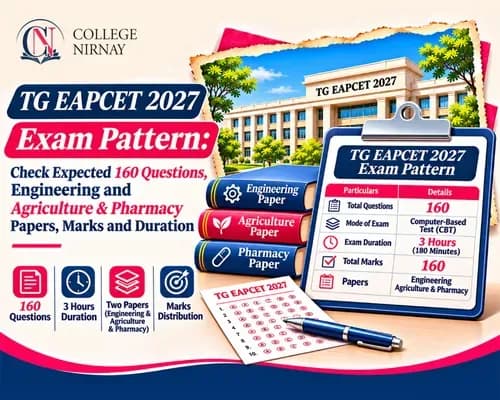
| Expected Total Questions | 160 |
| Expected Maximum Marks | 160 marks |
| Negative Marking | Not expected under the previous examination pattern |
| Official Syllabus Status | 2027 notification to be verified |
Students can check the detailed TG EAPCET Intermediate syllabus overview for additional information about the expected academic coverage and examination structure.
TG EAPCET 2027 Examination Language and Medium
Candidates preparing for TG EAPCET should understand the difference between the language of the question paper and the subjects included in the syllabus. The entrance examination primarily evaluates science and mathematics knowledge rather than language proficiency.
English
English has been a standard language of the entrance examination question paper.
Telugu
English and Telugu bilingual question papers have been available in previous examination cycles.
Urdu
English and Urdu options have also been offered under prescribed conditions. Candidates should verify the applicable 2027 arrangements.
Is English Included as a Separate Subject?
Under the established examination pattern, English, Telugu and Urdu are not separate scoring subjects in the Engineering or Agriculture & Pharmacy papers. Candidates are assessed through questions from their prescribed domain subjects.
Read more about the TG EAPCET examination language and syllabus requirements before selecting your preferred examination medium.
TG EAPCET Subject Wise Syllabus: Intermediate MPC and BiPC Chapters
The TG EAPCET chapter wise syllabus can be understood by separating the Intermediate First Year and Second Year topics for each subject. Mathematics is primarily relevant to Engineering candidates, while Botany and Zoology form the Biology component of the Agriculture & Pharmacy examination.
The following tables provide indicative Intermediate-level preparation topics. They should not be treated as an exhaustive reproduction of the official 2027 syllabus.
TG EAPCET Mathematics syllabus
Engineering Stream | Expected 80 QuestionsMathematics is expected to contribute half of the Engineering examination paper. Candidates should cover algebra, trigonometry, coordinate geometry, calculus, probability and vector-related applications while developing numerical accuracy.
| Intermediate 1st Year Topics | Intermediate 2nd Year Topics |
|---|---|
| Functions and mathematical induction | Complex numbers and De Moivre's theorem |
| Matrices and matrix operations | Quadratic expressions |
| Addition of vectors | Theory of equations |
| Product of vectors | Permutations and combinations |
| Trigonometric ratios and transformations | Binomial theorem |
| Trigonometric equations | Partial fractions |
| Inverse trigonometric functions | Measures of dispersion |
| Hyperbolic functions | Probability and random variables |
| Properties of triangles | Probability distributions |
| Locus and transformation of axes | Circles and systems of circles |
| Straight lines and pair of straight lines | Parabola |
| Three-dimensional coordinates | Ellipse |
| Direction cosines and direction ratios | Hyperbola |
| Plane | Indefinite integration |
| Limits and continuity | Definite integration |
| Differentiation and applications of derivatives | Differential equations |
TG EAPCET Physics syllabus
Both Streams | Expected 40 QuestionsPhysics is a common subject for MPC and BiPC candidates. The syllabus is expected to test theoretical concepts, scientific laws, physical quantities, graphical interpretation and numerical applications.
| Intermediate 1st Year Topics | Intermediate 2nd Year Topics |
|---|---|
| Physical world, units and measurements | Waves and wave phenomena |
| Motion in a straight line | Ray optics and optical instruments |
| Motion in a plane | Wave optics |
| Laws of motion and friction | Electric charges and fields |
| Work, energy and power | Electrostatic potential and capacitance |
| Systems of particles and rotational motion | Current electricity |
| Oscillations and simple harmonic motion | Moving charges and magnetism |
| Gravitation | Magnetism and matter |
| Mechanical properties of solids | Electromagnetic induction |
| Mechanical properties of fluids | Alternating current |
| Thermal properties of matter | Electromagnetic waves |
| Thermodynamics | Dual nature of radiation and matter |
| Kinetic theory of gases | Atoms, nuclei and nuclear physics |
| Applications of mechanics and thermal physics | Semiconductor electronics, subject to prescribed coverage |
TG EAPCET Chemistry syllabus
Both Streams | Expected 40 QuestionsChemistry includes Physical Chemistry, Organic Chemistry and Inorganic Chemistry. Candidates should develop numerical skills, understand chemical reactions and revise periodic properties, compounds and molecular structures.
| Intermediate 1st Year Topics | Intermediate 2nd Year Topics |
|---|---|
| Atomic structure | Solid state |
| Classification of elements and periodic properties | Solutions |
| Chemical bonding and molecular structure | Electrochemistry |
| States of matter | Chemical kinetics |
| Stoichiometry and mole concept | Surface chemistry |
| Thermodynamics | General principles of metallurgy |
| Chemical equilibrium | Selected p-block elements |
| Acids, bases and ionic equilibrium | d-block and f-block elements |
| Hydrogen and its compounds | Coordination compounds |
| s-block elements | Haloalkanes and haloarenes |
| Selected p-block elements | Alcohols, phenols and ethers |
| Environmental chemistry | Aldehydes, ketones and carboxylic acids |
| Basic principles of organic chemistry | Organic compounds containing nitrogen |
| Hydrocarbons | Biomolecules |
| Organic nomenclature and isomerism | Polymers and chemistry in everyday life, if prescribed |
TG EAPCET Botany syllabus
Agriculture & Pharmacy Stream | Expected 40 QuestionsBotany covers plant diversity, morphology, anatomy, physiology, cellular processes, genetics, biotechnology and related biological applications. Candidates interested in agriculture and allied science programmes should build a strong understanding of plant science.
| Intermediate 1st Year Topics | Intermediate 2nd Year Topics |
|---|---|
| The living world | Transport in plants |
| Biological classification | Mineral nutrition |
| Plant kingdom | Photosynthesis in higher plants |
| Morphology of flowering plants | Respiration in plants |
| Reproduction in plants | Plant growth and development |
| Sexual reproduction in flowering plants | Bacteria and viruses |
| Taxonomy of angiosperms | Principles of inheritance and variation |
| Cell structure and cellular organisation | Molecular basis of inheritance |
| Biomolecules | Biotechnology principles and processes |
| Cell cycle and cell division | Applications of biotechnology |
| Internal organisation of plants | Strategies for enhancement in food production |
| Plant ecology and ecological adaptations | Microbes and their applications in human welfare |
TG EAPCET Zoology syllabus
Agriculture & Pharmacy Stream | Expected 40 QuestionsZoology primarily focuses on animal diversity, structural organisation, disease-related concepts, human physiology, genetics, reproduction and evolution. Candidates should understand biological processes along with important terminology and scientific classifications.
| Intermediate 1st Year Topics | Intermediate 2nd Year Topics |
|---|---|
| Diversity of the living world | Digestion and absorption |
| Structural organisation in animals | Breathing and exchange of gases |
| Animal tissues and organisation | Body fluids and circulation |
| Invertebrate diversity | Excretory products and elimination |
| Chordate diversity | Locomotion and movement |
| Locomotion and reproduction in protozoa | Neural control and coordination |
| Biology and human welfare | Chemical coordination and integration |
| Parasitism and disease-causing organisms | Human reproduction |
| Structural and functional organisation of selected animals | Reproductive health |
| Ecology and environmental relationships | Genetics and inheritance |
| Population and ecosystem concepts | Organic evolution |
| Biodiversity and conservation concepts | Applied biology and animal husbandry topics |
TG EAPCET Biology syllabus: Botany and Zoology Combined
Biology in the Agriculture & Pharmacy examination has historically been divided into Botany and Zoology. Each section is expected to contain 40 questions, giving Biology a combined contribution of 80 questions out of the anticipated 160-question paper.
For additional guidance, explore the TG EAPCET subject wise syllabus and domain-specific topics on College Nirnay.
TG EAPCET Engineering vs Agriculture and Pharmacy Syllabus
The subject combination is one of the most important differences between the Engineering and Agriculture & Pharmacy examination papers. Although Physics and Chemistry are common to both streams, the main subject component differs.
Engineering Stream – MPC
Expected 160 Questions | 160 Marks
TG EAPCET Engineering syllabus includes Mathematics, Physics and Chemistry.
Potential Admission Areas
- B.Tech and applicable engineering programmes
- Selected technology programmes
- Other notified courses accepting the Engineering stream
Agriculture & Pharmacy – BiPC
Expected 160 Questions | 160 Marks
TG EAPCET Agriculture and Pharmacy syllabus includes Botany, Zoology, Physics and Chemistry.
Potential Admission Areas
- Applicable agriculture programmes
- Applicable horticulture programmes
- B.Pharm and Pharm.D programmes where eligible
- Other notified allied science programmes
Expected Subject-Wise Question Distribution
| Subject | Engineering | Agriculture & Pharmacy |
|---|---|---|
| Mathematics | 80 | Not Applicable |
| Botany | Not Applicable | 40 |
| Zoology | Not Applicable | 40 |
| Physics | 40 | 40 |
| Chemistry | 40 | 40 |
| Total Questions | 160 | 160 |
Are General Knowledge and Reasoning Included?
The established TG EAPCET examination format does not include separate General Knowledge, Logical Reasoning, English proficiency or Current Affairs sections. Candidates should prioritise the prescribed domain subjects unless the official 2027 notification introduces changes.
Check the general syllabus requirements for TG EAPCET to understand the examination stream and subject coverage.
TG EAPCET Important Chapters and High Weightage Preparation Topics
Identifying TG EAPCET important chapters can help students organise their preparation more effectively. However, candidates should not interpret a suggested preparation priority as an officially guaranteed chapter-wise question distribution.
Students searching for TG EAPCET high weightage topics should analyse multiple previous-year papers, consider the difficulty of individual chapters and assess their own accuracy before deciding which units require additional study time.
Mathematics
- Differentiation and integration
- Matrices
- Probability
- Vector algebra
- Complex numbers
- Coordinate geometry
- Trigonometry
- Differential equations
Physics
- Laws of motion
- Rotational motion
- Thermodynamics
- Current electricity
- Electrostatics
- Magnetism
- Ray and wave optics
- Modern physics
Chemistry
- Chemical bonding
- Atomic structure
- Chemical equilibrium
- Electrochemistry
- Chemical kinetics
- Coordination compounds
- Organic reaction mechanisms
- Hydrocarbons and functional groups
Botany
- Plant physiology
- Photosynthesis
- Plant reproduction
- Cell structure and division
- Genetics
- Biotechnology
- Plant classification
- Plant anatomy
Zoology
- Human physiology
- Animal classification
- Neural coordination
- Endocrine regulation
- Human reproduction
- Genetics
- Evolution
- Human welfare
Common Revision Areas
- Core scientific definitions
- Formula-based applications
- Graphical interpretation
- Scientific diagrams
- Experimental principles
- Units and dimensions
- Conceptual MCQs
- Previous-year question analysis
How to Identify High-Priority Chapters Using Previous-Year Papers
Use multiple examination years and shifts rather than relying on a single question paper.
Identify the main concept being tested and classify questions under corresponding Intermediate units.
Determine which concepts appear regularly and which types of questions require more time or advanced problem-solving.
Record incorrect answers and identify the chapters where conceptual mistakes or calculation errors occur repeatedly.
Allocate additional revision time to frequently assessed concepts and weak chapters without completely excluding other prescribed topics.
Candidates can explore more TG EAPCET preparation topics and important syllabus features to plan their revision strategy.
Intermediate 1st Year vs 2nd Year: Which Syllabus Should Students Prioritise?
A common question among entrance examination aspirants is whether they should spend more time revising First Year topics or focus on Second Year chapters that are more recently studied.
The most effective approach is to understand how the concepts from both academic years are connected. First Year topics frequently provide foundational knowledge required for advanced Second Year problem-solving.
Build Conceptual Foundations
- Basic mathematical operations and algebra
- Trigonometric identities and functions
- Mechanics and rotational motion
- Atomic structure and chemical bonding
- Cell biology and biological classification
- Plant morphology and animal diversity
First Year preparation should focus on strengthening core concepts that are required for solving advanced questions.
Develop Advanced Application Skills
- Integration and differential equations
- Advanced coordinate geometry
- Electricity, magnetism and optics
- Electrochemistry and organic chemistry
- Plant physiology and biotechnology
- Human physiology and genetics
Second Year preparation should combine conceptual revision with timed objective-question practice.
How First Year Concepts Support Second Year Preparation
| Subject | First Year Foundation | Second Year Application |
|---|---|---|
| Mathematics | Functions, limits and differentiation | Integration and differential equations |
| Physics | Motion, vectors, force and energy | Electric fields and magnetic forces |
| Chemistry | Chemical bonding and organic fundamentals | Coordination chemistry and organic reactions |
| Botany | Cell biology and plant anatomy | Plant physiology and biotechnology |
| Zoology | Animal tissues and structural organisation | Human physiology and organ systems |
Suggested First Year and Second Year Revision Time
Students who have recently completed their Second Year studies may need additional time to recall First Year chapters. The following division can be used as an adjustable starting point.
This is a suggested personal study-time allocation, not the official year-wise weightage of the examination.
Common Syllabus Preparation Mistakes
Skipping foundational chapters can create difficulties in understanding advanced topics and solving mixed-concept questions.
Chapter predictions cannot guarantee which questions will appear in the actual 2027 examination.
Learning formulas without understanding their applications can reduce accuracy in numerical questions.
Candidates should compare their preparation material with the official 2027 syllabus after its publication.
Completing chapters without practising within examination time limits may create difficulties during the actual CBT.
Both MPC and BiPC candidates should allocate sufficient preparation time to Physics and Chemistry.
For a detailed comparison, visit the TG EAPCET syllabus differences and academic subject coverage section.
How to Download TG EAPCET Syllabus PDF 2027 and Prepare for the Examination
The official syllabus PDF will be an important document for candidates preparing for the 2027 entrance examination. Students should download the correct stream-specific syllabus and check whether any chapters, subtopics or academic requirements have been revised.
Steps to Download the Official Syllabus
- Visit the official TG EAPCET examination portal.
- Locate the syllabus or examination information section.
- Select the Engineering or Agriculture & Pharmacy syllabus.
- Open the PDF applicable to the 2027 examination.
- Verify the academic year mentioned in the document.
- Download and save the syllabus for future reference.
- Compare the official chapters with your Intermediate textbooks and preparation notes.
Suggested 120-Day TG EAPCET Preparation Plan
Candidates beginning their preparation several months before the examination can divide the complete syllabus into four preparation phases. Each phase should combine chapter coverage, revision and assessment.
Foundation Building
- Revise First Year fundamentals
- Prepare formula notes
- Identify weak chapters
- Practise basic MCQs
Syllabus Completion
- Complete remaining chapters
- Cover advanced concepts
- Practise chapter-wise tests
- Revise difficult units
Question Practice
- Solve previous-year papers
- Attempt subject-wise mocks
- Analyse incorrect answers
- Improve calculation speed
Final Revision
- Attempt full-length CBT mocks
- Revise formulas and reactions
- Review biological diagrams
- Strengthen time management
Suggested Daily Study Timetable for MPC Students
| Study Activity | Suggested Time | Daily Objective |
|---|---|---|
| Mathematics | 120 Minutes | Concept revision and numerical practice |
| Physics | 60 Minutes | Theory, formulas and numerical questions |
| Chemistry | 60 Minutes | Reactions and conceptual MCQs |
| Timed Practice | 45 Minutes | Mixed-subject questions |
| Error Analysis | 15 Minutes | Review mistakes and update notes |
| Total Study Time | 5 Hours | Excluding breaks |
Suggested Daily Study Timetable for BiPC Students
| Study Activity | Suggested Time | Daily Objective |
|---|---|---|
| Botany | 60 Minutes | Plant science and diagram revision |
| Zoology | 60 Minutes | Human physiology and biological concepts |
| Physics | 60 Minutes | Numerical and theory-based questions |
| Chemistry | 60 Minutes | Reactions, concepts and formulas |
| Timed Practice | 45 Minutes | Mixed-subject MCQs |
| Error Analysis | 15 Minutes | Review incorrect responses |
| Total Study Time | 5 Hours | Excluding breaks |
These timetables are suggested preparation schedules. Candidates can adjust their study hours according to board examination commitments, personal strengths and available preparation time.
TG EAPCET Subject-Wise Syllabus Completion Tracker
Candidates can use the following checklist to review their progress across major subject areas. Complete only the subjects applicable to your selected examination stream.
| Subject Area | 1st Year Completed | 2nd Year Completed | Revision Completed |
|---|---|---|---|
| Mathematics | |||
| Physics | |||
| Chemistry | |||
| Botany | |||
| Zoology |
The checklist is intended for use during the current page session. Progress may not be retained after refreshing the page.
Recommended Study Resources
- Telangana Intermediate First Year and Second Year prescribed textbooks.
- Official stream-specific entrance examination syllabus.
- Previous-year question papers and answer keys.
- Chapter-wise objective question banks.
- Full-length computer-based mock examinations.
- Personal formula sheets, chemical reaction notes and biological diagrams.
- Weekly preparation assessments and error-analysis notebooks.
TG EAPCET 2027 Syllabus – Frequently Asked Questions
Check commonly asked questions about Intermediate subject coverage, examination streams, important chapters, syllabus PDFs and preparation requirements.
1. Has the TG EAPCET syllabus 2027 been officially released?
The final 2027 syllabus has not been independently verified as of November 27, 2026. Candidates should regularly check the official examination portal for the applicable syllabus and notification.
2. What subjects are included in the TG EAPCET 2027 syllabus?
Engineering candidates prepare Mathematics, Physics and Chemistry, while Agriculture & Pharmacy candidates prepare Botany, Zoology, Physics and Chemistry.
3. What is covered in the TG EAPCET Intermediate 1st Year syllabus?
The expected coverage includes foundational algebra, trigonometry, mechanics, atomic structure, chemical bonding, plant diversity, cell biology and animal organisation, depending on the selected stream.
4. What is covered in the TG EAPCET Intermediate 2nd Year syllabus?
Expected topics include integration, differential equations, electricity, magnetism, optics, electrochemistry, organic chemistry, plant physiology, genetics and human physiology.
5. What subjects are included in the TG EAPCET MPC syllabus?
MPC refers to Mathematics, Physics and Chemistry. These subjects form the established Engineering examination paper.
6. What subjects are included in the TG EAPCET BiPC syllabus?
BiPC candidates prepare Biology, Physics and Chemistry. Biology is further divided into Botany and Zoology in the Agriculture & Pharmacy examination.
7. How many subjects are included in the TG EAPCET Engineering syllabus?
The Engineering syllabus consists of three subjects: Mathematics, Physics and Chemistry. The expected paper contains 80 Mathematics questions and 40 questions each from Physics and Chemistry.
8. What is the TG EAPCET Agriculture and Pharmacy syllabus?
The examination includes Botany, Zoology, Physics and Chemistry, with an expected distribution of 40 questions from each subject.
9. Which chapters are included in the TG EAPCET Mathematics syllabus?
Major preparation areas include algebra, matrices, trigonometry, vectors, coordinate geometry, calculus, probability, complex numbers and differential equations. Exact coverage should be checked against the official PDF.
10. What should students study for the TG EAPCET Physics syllabus?
Students should prepare mechanics, thermodynamics, waves, electrostatics, current electricity, magnetism, optics and modern physics according to the prescribed syllabus.
11. Does the TG EAPCET Chemistry syllabus include Organic Chemistry?
Yes. The established Chemistry coverage includes Physical, Organic and Inorganic Chemistry. Candidates should verify the specific chapters and reactions prescribed for 2027.
12. What topics are included in the TG EAPCET Botany syllabus?
Botany preparation generally includes plant classification, morphology, anatomy, reproduction, cell biology, plant physiology, genetics and biotechnology.
13. Does the TG EAPCET Zoology syllabus include human physiology?
Human physiology is an important part of Intermediate Zoology. Candidates should prepare organ systems, regulation, reproduction, genetics and other prescribed animal science topics.
14. How many questions are expected from the TG EAPCET Biology syllabus?
Biology is expected to contribute 80 questions to the Agriculture & Pharmacy paper, including 40 Botany questions and 40 Zoology questions.
15. Where can candidates check the TG EAPCET subject wise syllabus?
Candidates can explore subject-wise preparation information on College Nirnay and verify the complete prescribed syllabus through the official TG EAPCET examination portal.
16. How should students complete the TG EAPCET chapter wise syllabus?
Students should study foundational chapters first, complete advanced units, solve chapter-wise MCQs, revise regularly and assess their progress through timed tests.
17. What are the TG EAPCET important chapters for Engineering?
Calculus, algebra, coordinate geometry, mechanics, electricity, chemical bonding, equilibrium and organic chemistry are useful preparation priorities. No chapter-specific question count is guaranteed.
18. Are TG EAPCET high weightage topics officially fixed?
Candidates should not assume that a specific number of questions from each chapter is guaranteed. Previous-year paper trends can support preparation decisions but cannot predict the exact 2027 paper.
19. How can I download the TG EAPCET syllabus PDF 2027?
Visit the official examination website after the applicable syllabus is published, select your examination stream and download the PDF for the 2027 academic cycle.
20. Which TG EAPCET preparation topics should students study first?
Students should begin with foundational concepts such as algebra, basic mechanics, atomic structure, chemical bonding, cell biology and other prerequisites relevant to their stream.
21. Is the Telangana EAPCET syllabus 2027 based on Intermediate textbooks?
The examination has historically been based on Intermediate-level subject coverage. Students should use prescribed Telangana Intermediate textbooks together with the official entrance examination syllabus.
22. Can students prepare for the TG EAPCET Intermediate syllabus using NCERT books?
NCERT textbooks may support conceptual understanding, but candidates should compare their chapter coverage with Telangana Intermediate textbooks and the official TG EAPCET syllabus to avoid missing prescribed topics.
23. Is Mathematics compulsory for the Engineering examination?
Yes. Mathematics is an integral part of the standard Engineering entrance examination paper and is expected to account for 80 of the 160 questions.
24. Do BiPC candidates have to answer Mathematics questions?
Mathematics is not part of the standard Agriculture & Pharmacy examination paper. BiPC candidates generally answer Botany, Zoology, Physics and Chemistry questions.
25. Are Physics and Chemistry common to both examination streams?
Yes. Physics and Chemistry form part of both the Engineering and Agriculture & Pharmacy papers. Candidates should check the exact syllabus prescribed for their stream.
26. Is the syllabus different from the Intermediate board examination syllabus?
Although the entrance examination is based on Intermediate-level concepts, the official entrance syllabus may prescribe specific topics or exclusions. The objective-question format also requires a different preparation approach from board examinations.
27. Is there a separate English or General Knowledge section?
Under the established examination structure, there is no separate English, General Knowledge or reasoning section. Students are assessed through the prescribed science and mathematics subjects.
28. Can students skip Intermediate First Year chapters?
Skipping First Year chapters is not recommended because questions may be drawn from both academic years, and several advanced topics depend on First Year fundamentals.
29. Is there a fixed 50:50 weightage for First Year and Second Year topics?
Candidates should not assume an exact year-wise question distribution unless specified in the official 2027 examination documents. Both academic years should receive adequate preparation time.
30. How many months are required to complete the syllabus?
The required preparation period depends on a student's existing knowledge, available study hours and academic commitments. A four-month structured plan can be a useful starting point for candidates with a reasonable understanding of Intermediate concepts.
31. Are previous-year papers sufficient to complete the syllabus?
Previous-year papers are valuable for understanding question formats and identifying weak concepts. However, they should be combined with complete syllabus coverage, textbook revision and mock tests.
32. Will TG EAPCET 2027 have negative marking?
Previous examination patterns have awarded one mark for each correct answer without negative marking. The final 2027 marking scheme should be verified from the official notification.
33. Can candidates select both Engineering and Agriculture & Pharmacy streams?
Candidates may be able to apply for both streams if they satisfy the prescribed academic eligibility requirements and follow the applicable registration rules. They should check the official 2027 information bulletin before applying.
34. Is the TG EAPCET Agriculture & Pharmacy paper used for MBBS admissions?
No. MBBS admissions are conducted through NEET-UG under the applicable admission framework. TG EAPCET is intended for the engineering, agriculture, pharmacy and other notified programmes under its admission system.
35. What should candidates do if the official 2027 syllabus changes?
Candidates should compare the newly released syllabus with their current preparation checklist, identify additions or exclusions, update their study material and revise their preparation schedule accordingly.
Read additional TG EAPCET syllabus FAQs on College Nirnay for further examination guidance.
Conclusion
Candidates preparing for TG EAPCET 2027 should begin by understanding the Intermediate First Year and Second Year curriculum applicable to their chosen examination stream. Engineering aspirants should prioritise Mathematics alongside Physics and Chemistry, while Agriculture & Pharmacy aspirants should maintain balanced preparation across Botany, Zoology, Physics and Chemistry.
Instead of depending exclusively on predicted important chapters, students should complete the prescribed syllabus, solve previous-year questions, attempt computer-based mock tests and maintain a regular revision schedule. A structured preparation approach can help improve conceptual understanding, examination speed and accuracy.
The final syllabus, subject distribution, examination language options and marking scheme should be verified once the official 2027 examination documents become available.
Stay connected with College Nirnay for the latest TG EAPCET 2027 syllabus updates, entrance examination information and admission guidance.
Explore More TG EAPCET Syllabus Information
Official Reference and Verification
Official examination portal: eapcet.tgche.ac.in
Disclaimer: The information presented above is an indicative preparation guide for the 2027 examination. The official examination authority's notification, syllabus PDF and admission guidelines will take precedence over expected subject coverage and examination details mentioned in this article.