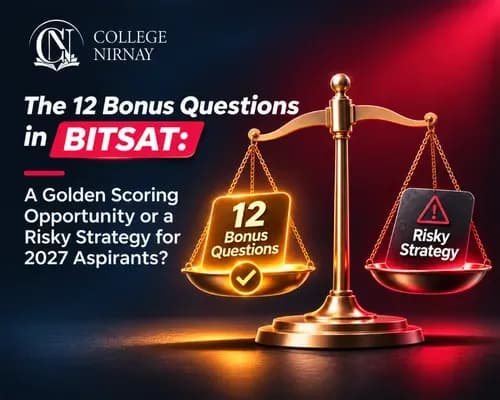
The 12 Bonus Questions in BITSAT: A Golden Scoring Opportunity or a Risky Strategy for 2027 Aspirants?
Imagine completing 130 questions in BITSAT with sufficient time remaining and discovering that you have an opportunity to attempt another 12 questions. Should you immediately unlock these additional questions to increase your score, or should you spend the remaining time reviewing your existing answers?
The BITSAT 12 bonus questions facility is one of the distinctive features of the examination. Unlike conventional engineering entrance examinations, the previous BITSAT format provided sufficiently fast candidates with an opportunity to attempt additional questions after completing the original paper.
However, developing an effective BITSAT 2027 bonus question strategy requires much more than increasing your calculation speed. Students must understand negative marking, the conditions for unlocking additional questions and the consequences of permanently losing access to their original answers.
The BITSAT maximum score with bonus questions is theoretically 426 marks under the previous examination framework, compared with 390 marks for the standard paper. Nevertheless, attempting additional questions does not automatically guarantee a higher score.
This detailed guide explains the expected BITSAT 2027 exam pattern, the mathematical relationship between accuracy and additional marks, practical scoring scenarios and the circumstances under which attempting bonus questions may actually reduce your examination performance.
This article uses the examination framework specified in the official BITSAT 2025 and 2026 brochures. Students must verify the final 2027 examination pattern, additional-question provisions, marking scheme and test interface instructions when the new admission brochure becomes available.
Understanding the BITSAT 2027 Examination Pattern
BITSAT is a computer-based entrance examination that evaluates students across science subjects, English language proficiency and analytical reasoning. The examination requires a combination of conceptual understanding, calculation efficiency, accuracy and effective decision-making.
The BITSAT 130 questions strategy should form the foundation of every student's preparation plan. Additional questions should be considered an optional scoring opportunity rather than an essential component of achieving a competitive admission score.
Students targeting BITSAT 390 marks must understand that this represents the maximum possible score in the standard examination, assuming that every original question is answered correctly. It is not a minimum admission requirement or a fixed qualifying cutoff.
General Examination Pattern at a Glance
| Examination Particular | Previous Examination Framework |
|---|---|
| Examination Mode | Computer-based test |
| Standard Questions | 130 |
| Additional Questions | Up to 12, subject to eligibility |
| Total Potential Questions | 142 |
| Question Format | Single-answer objective questions |
| Correct Answer | +3 marks |
| Incorrect Answer | -1 mark |
| Unanswered Question | 0 marks |
| Standard Maximum Marks | 390 |
| Theoretical Maximum With Additional Questions | 426 |
| Examination Duration | 180 minutes |
| Individual Sectional Time Limit | None under the previous pattern |
| Additional Time for Bonus Questions | No separate additional time |
Understanding the Difference Between 390 and 426 Marks
130 × 3 Marks
Maximum possible score without attempting additional questions.
142 × 3 Marks
Theoretical maximum when all original and additional answers are correct.
Maximum Scoring Potential
The maximum additional scoring opportunity is 36 marks, approximately 9.23% of the standard maximum score.
Aiming for BITSAT 426 marks represents a theoretical perfect-score objective. A more practical preparation target should be determined through mock test performance, academic readiness and the competitive requirements of your preferred programme.
Explore more details in the BITSAT General Examination Pattern section.
How the Standard Paper and Additional Questions Work
The additional-question feature is not a separate examination paper or a third examination session. It is an optional extension of an individual BITSAT attempt.
Understanding BITSAT additional questions eligibility is essential because candidates cannot directly access the additional-question section at the beginning of their examination.
Three Conditions for Unlocking Additional Questions
Complete All Original Questions
Every question in the original set must have a recorded answer before the additional-question option becomes accessible.
Have Remaining Examination Time
Candidates must complete the original paper before the overall examination timer expires.
Accept the Answer Lock
Candidates must be willing to finalise the original responses without another opportunity to correct them.
Additional Question Access Flowchart
Does Answering Every Question Mean Answering Every Question Correctly?
No. The historical unlocking condition relates to submitting responses for all original questions rather than obtaining a perfect score in them.
However, completing every question through random guessing simply to access the additional section could expose candidates to unnecessary score deductions. Students should evaluate whether the potential benefit outweighs the uncertainty created by their existing answers.
Additional-question eligibility and additional-question readiness are different. A candidate may satisfy the technical unlocking conditions without having the preparation, accuracy or available time needed to benefit from them.
Read the BITSAT Paper Structure section to understand the relationship between the original and extended examination formats.
BITSAT Subject-Wise Question and Marks Distribution
The BITSAT extra questions subject distribution plays an important role in deciding whether accessing the extended examination is beneficial for a particular candidate.
Additional questions are distributed equally across four applicable areas, meaning that a student cannot depend exclusively on Mathematics or Biology to obtain all 36 potential additional marks.
Subject-Wise Distribution of Standard and Additional Questions
| Subject | Standard Questions | Additional Questions | Potential Total Questions | Maximum Marks |
|---|---|---|---|---|
| Physics | 30 | 3 | 33 | 99 |
| Chemistry | 30 | 3 | 33 | 99 |
| English Proficiency | 10 | 0 | 10 | 30 |
| Logical Reasoning | 20 | 3 | 23 | 69 |
| Mathematics or Biology | 40 | 3 | 43 | 129 |
| Total | 130 | 12 | 142 | 426 |
Standard Question Distribution
Additional Question Distribution
Mathematics vs Biology: Does the Bonus Strategy Change?
Mathematics Route
- Prioritise algebraic simplification and calculation speed.
- Revise calculus, coordinate geometry and probability.
- Practise identifying shorter solution methods.
- Avoid spending excessive time on lengthy calculations.
- Maintain strong Physics, Chemistry and reasoning preparation.
Biology Route
- Strengthen biological terminology and conceptual recall.
- Revise genetics, physiology, reproduction and ecology.
- Practise interpreting biological statements and diagrams.
- Maintain accuracy when choosing between similar alternatives.
- Continue timed Physics, Chemistry and reasoning practice.
The suggested revision topics are preparation examples rather than confirmed 2027 chapter weightages. The Biology route was available for specified programmes under the previous admission rules; candidates must verify their programme-specific eligibility.
Preparing for BITSAT 142 questions requires balanced subject knowledge. Excellent Mathematics or Biology performance alone cannot compensate for weak preparation in every other additional-question subject.
Explore the detailed BITSAT Subject-Wise Question Distribution before finalising your preparation priorities.
Bonus Question Difficulty, Eligibility and Answer Locking
One of the most important BITSAT bonus questions risks is that candidates must give up access to their original responses before entering the additional-question section.
Students sometimes assume that they can inspect the extra questions, attempt the easier ones and then return to their original paper. However, the historical examination rules do not provide this flexibility.
Understanding BITSAT Answer Locking Rules
Before Unlocking Additional Questions
- Navigate through the original questions.
- Review calculation-based answers.
- Correct identified mistakes.
- Reconsider uncertain responses.
- Complete previously unanswered questions.
After Unlocking Additional Questions
- Original responses become final.
- Previous calculation errors cannot be corrected.
- Uncertain original answers cannot be revised.
- Only the remaining eligible examination activity is available.
- The existing examination timer continues.
Are Bonus Questions More Difficult Than Standard Questions?
The BITSAT bonus questions difficulty level cannot be reliably classified as uniformly easy, moderate or difficult. There is no officially established rule promising that additional questions will be easier or consistently harder than the original paper.
Students may experience additional pressure because they encounter unfamiliar questions during the final stage of the examination, when available time and mental energy are limited.
Types of Questions Students Can Practise
| Subject | Suggested Practice Areas | Essential Skill |
|---|---|---|
| Physics | Mechanics, electricity, optics, thermodynamics and modern physics | Formula selection and numerical accuracy |
| Chemistry | Chemical bonding, equilibrium, electrochemistry and organic reactions | Concept recall and option elimination |
| Mathematics | Calculus, algebra, vectors, coordinate geometry and probability | Fast and reliable problem-solving |
| Biology | Genetics, biotechnology, physiology, reproduction and ecology | Accurate conceptual recall |
| Logical Reasoning | Series, analogies, classifications, patterns and analytical relationships | Pattern recognition and logical deduction |
These are illustrative practice areas, not verified predictions of the chapters that will appear in the additional-question section.
Original Practice Examples for Additional Question Preparation
Two resistors of 6 Ω and 3 Ω are connected in parallel. What is their equivalent resistance?
A. 9 Ω
B. 2 Ω
C. 3 Ω
D. 4.5 Ω
View Answer and Explanation
Correct answer: B. The equivalent resistance is (6 × 3) ÷ (6 + 3) = 18 ÷ 9 = 2 Ω.
For a reaction with rate = k[A]², what happens to the reaction rate when the concentration of A is doubled while other conditions remain unchanged?
A. It remains unchanged
B. It doubles
C. It becomes four times
D. It becomes eight times
View Answer and Explanation
Correct answer: C. The concentration is raised to the power of two, so doubling it increases the reaction rate by 2² = 4 times.
If f(x) = x³ + 2x, what is the value of f'(2)?
A. 10
B. 12
C. 14
D. 16
View Answer and Explanation
Correct answer: C. Differentiating gives f'(x) = 3x² + 2. Substituting x = 2 gives 12 + 2 = 14.
In a monohybrid cross between two heterozygous individuals, Tt × Tt, what is the probability of obtaining the homozygous recessive genotype?
A. 0%
B. 25%
C. 50%
D. 75%
View Answer and Explanation
Correct answer: B. The expected genotype ratio is 1 TT : 2 Tt : 1 tt. The probability of obtaining tt is 1/4 or 25%.
Identify the next number in the sequence: 2, 6, 12, 20, 30, ?
A. 36
B. 40
C. 42
D. 44
View Answer and Explanation
Correct answer: C. The successive differences are 4, 6, 8 and 10. The next difference is 12, giving 30 + 12 = 42.
These are original illustrative questions created for practice. They are not represented as official BITSAT previous-year or additional questions.
Visit the BITSAT Question Types and Examination Format section for more information.
Marking Scheme, Negative Marking and Score Calculations
Understanding the BITSAT bonus questions marking scheme is essential because the additional questions are scored using the same historical correct-answer and incorrect-answer framework as the standard paper.
The expected BITSAT negative marking 2027 provisions should be confirmed in the new brochure. If the previous examination framework continues, incorrect answers will reduce the total score rather than simply providing zero additional marks.
Marks added to the score
Mark deducted from the score
No marks added or deducted
BITSAT Score Calculation Formula
Additional Score = (Correct Extra Answers × 3) − Incorrect Extra Answers
How Many Additional Questions Must Be Correct to Increase Your Score?
If a candidate attempts all 12 additional questions, the resulting change in score depends on how many answers are correct.
Let C represent the number of correct answers. Because all 12 questions have been attempted, the number of incorrect answers is 12 − C.
| Correct | Incorrect | Accuracy | Score Change | Outcome |
|---|---|---|---|---|
| 0 | 12 | 0% | -12 | Score reduction |
| 1 | 11 | 8.33% | -8 | Score reduction |
| 2 | 10 | 16.67% | -4 | Score reduction |
| 3 | 9 | 25% | 0 | Break-even |
| 4 | 8 | 33.33% | +4 | Small improvement |
| 5 | 7 | 41.67% | +8 | Positive improvement |
| 6 | 6 | 50% | +12 | Positive improvement |
| 7 | 5 | 58.33% | +16 | Meaningful improvement |
| 8 | 4 | 66.67% | +20 | Meaningful improvement |
| 9 | 3 | 75% | +24 | Strong improvement |
| 10 | 2 | 83.33% | +28 | Strong improvement |
| 11 | 1 | 91.67% | +32 | Excellent improvement |
| 12 | 0 | 100% | +36 | Maximum improvement |
When all 12 additional questions are attempted, three correct answers and nine incorrect answers produce zero net additional marks. Four correct answers produce a positive score change.
However, achieving a positive additional score does not prove that unlocking was the best decision. Reviewing the original paper might have produced an even greater improvement within the same available time.
Accuracy vs Additional Score Graph
The graph is a mathematical illustration of the historical +3/-1 marking scheme. It is not based on actual student performance data.
Five Practical Score Calculation Scenarios
Scenario 1: High Accuracy With Additional Questions
Original correct answers: 115
Original incorrect answers: 15
Standard score: (115 × 3) − 15 = 330
Additional correct answers: 10
Additional incorrect answers: 2
Additional score: 30 − 2 = 28
Scenario 2: Additional Questions Reduce the Score
Original correct answers: 110
Original incorrect answers: 20
Standard score: 330 − 20 = 310
Additional correct answers: 2
Additional incorrect answers: 10
Additional score: 6 − 10 = -4
Scenario 3: Break-Even Performance
Original correct answers: 105
Original incorrect answers: 25
Standard score: 315 − 25 = 290
Additional correct answers: 3
Additional incorrect answers: 9
Additional score: 9 − 9 = 0
Scenario 4: Selective Additional Question Attempt
Original correct answers: 120
Original incorrect answers: 10
Standard score: 360 − 10 = 350
Additional correct answers: 7
Additional incorrect answers: 1
Additional unanswered questions: 4
Additional score: 21 − 1 = 20
Scenario 5: Theoretical Perfect Score
Original correct answers: 130
Original incorrect answers: 0
Standard score: 130 × 3 = 390
Additional correct answers: 12
Additional incorrect answers: 0
Additional score: 12 × 3 = 36
All five scenarios are hypothetical calculations. Candidates must follow the applicable 2027 test interface regarding unanswered additional questions.
Comparing Standard Scores and Final Scores
All bars use a common scale of 426 marks.
Is Random Guessing Worth the Risk?
Under a marking scheme that awards three marks for correct answers and deducts one mark for incorrect answers, the mathematical value of an attempted question depends on the probability of answering it correctly.
Here, p represents the probability that the selected answer is correct.
| Remaining Options | Correct Answer Probability | Expected Marks |
|---|---|---|
| 4 options: No elimination | 25% | 0 |
| 3 options: One incorrect option eliminated | 33.33% | +0.33 |
| 2 options: Two incorrect options eliminated | 50% | +1 |
| 1 option: Correct answer identified | 100% | +3 |
These calculations assume that eliminated alternatives are genuinely incorrect and that the remaining alternatives are equally likely. Incorrect elimination can reduce the actual probability of success.
Random guessing across four options has zero average expected marks under this model. It does not guarantee a zero score change in an individual examination, and substantial score losses remain possible.
The Hidden Cost of Unlocking Additional Questions
A successful BITSAT high scoring strategy must compare the potential benefit of new questions with the potential benefit of correcting existing mistakes.
Change from -1 to +3
Change from 0 to +3
Correcting three genuinely incorrect original responses can improve a candidate's score by 12 marks. Solving four additional questions correctly would also provide 12 marks, assuming no additional incorrect responses.
| Original Mistakes Successfully Corrected | Score Improvement | Minimum Correct Extra Answers to Match or Exceed* |
|---|---|---|
| 1 | +4 | 2 |
| 2 | +8 | 3 |
| 3 | +12 | 4 |
| 5 | +20 | 7 |
| 9 | +36 | 12 |
*Assuming no incorrect additional answers. Actual review outcomes are uncertain because candidates cannot directly determine which existing answers are incorrect during the examination.
Learn more about score calculations through the BITSAT Marking Scheme section.
Time Management and Bonus Question Attempt Strategy
Effective BITSAT 2027 time management requires candidates to balance question completion, answer accuracy and review time. Attempting additional questions should not force students to rush through the original paper.
A well-designed BITSAT question attempt strategy separates easy, moderate and time-consuming questions into manageable stages instead of treating all questions as equally demanding.
Average Time Available Per Question
10,800 seconds ÷ 130 questions
10,800 seconds ÷ 142 questions
These averages do not account for separate review periods. Actual question-solving targets should be adjusted according to individual subject strengths and question difficulty.
How Much Time Should You Reserve for Additional Questions?
| Reserved Time | Time for Standard Questions and Review | Standard Average | Extra Question Average |
|---|---|---|---|
| 10 Minutes | 170 Minutes | 78.5 Seconds | 50 Seconds |
| 15 Minutes | 165 Minutes | 76.2 Seconds | 75 Seconds |
| 20 Minutes | 160 Minutes | 73.8 Seconds | 100 Seconds |
| 25 Minutes | 155 Minutes | 71.5 Seconds | 125 Seconds |
| 30 Minutes | 150 Minutes | 69.2 Seconds | 150 Seconds |
Reserving additional time is useful only when candidates can complete and sufficiently review their original responses without compromising accuracy. There is no official minimum recommended time for unlocking extra questions.
Strategy A: Accuracy-First Standard Paper
This suggested plan is suitable for students who are still improving calculation speed or whose mock tests reveal frequent avoidable mistakes.
Total: 180 Minutes
Strategy B: Balanced Additional Question Plan
This suggested schedule is suitable for students who consistently finish the original questions early during realistic full-length mock examinations.
Total: 180 Minutes
Strategy C: Advanced Speed and Accuracy Plan
This approach should only be considered by students who have repeatedly demonstrated both high accuracy and rapid question completion in realistic practice tests.
Total: 180 Minutes
These are three independent planning models, not official sectional time limits. Students should select and adapt one strategy rather than combining their allocated time periods.
Recommended Three-Round Question Attempt Method
Round 1: High-Confidence Questions
Complete questions with familiar concepts, direct formulas and manageable calculations. Temporarily leave questions that require significantly more time.
Illustrative time allocation: First 80 minutes.
Round 2: Moderate and Unfinished Questions
Return to unanswered questions, apply systematic problem-solving and avoid sacrificing reliable marks merely to complete the entire paper.
Illustrative time allocation: Minutes 80–140.
Round 3: Review and Final Decision
Verify flagged calculations, reconsider genuinely uncertain responses and decide whether entering the additional-question section offers better scoring potential than continued review.
Illustrative time allocation: Final 40 minutes, including any extra-question attempt.
Should You Unlock Additional Questions With Limited Time Remaining?
| Remaining Time | Practical Consideration |
|---|---|
| Less than 5 Minutes | Very limited time; prioritise resolving identifiable original-paper mistakes unless mock-tested circumstances support another choice. |
| 5–10 Minutes | Could permit a small number of additional attempts, but only after evaluating review needs and answer confidence. |
| 10–20 Minutes | May provide a reasonable opportunity for fast, accurate candidates with reviewed original responses. |
| More Than 20 Minutes | Allows greater decision-making flexibility, provided original answers are sufficiently reliable. |
Review the complete BITSAT Examination Duration information when planning your examination-day schedule.
Expected Changes and Preparation Strategies for BITSAT 2027
Students planning BITSAT 2027 score improvement should prepare according to the established examination structure while remaining flexible enough to adapt to any officially announced modifications.
Effective BITSAT bonus questions preparation tips should focus on improving fundamental examination performance rather than trying to predict exact additional questions.
BITSAT Pattern Comparison: 2025, 2026 and 2027
| Examination Feature | 2025 | 2026 | 2027 |
|---|---|---|---|
| Standard Questions | 130 | 130 | Awaiting Confirmation |
| Additional Questions | 12 | 12 | Awaiting Confirmation |
| Standard Maximum Marks | 390 | 390 | Awaiting Confirmation |
| Theoretical Extended Maximum | 426 | 426 | Awaiting Confirmation |
| Marking Scheme | +3/-1 | +3/-1 | Awaiting Confirmation |
| Duration | 180 Minutes | 180 Minutes | Awaiting Confirmation |
| Original Answer Lock | Applicable | Applicable | Awaiting Confirmation |
Subject-Wise Preparation for Additional Questions
Physics Preparation
- Maintain a chapter-wise formula notebook.
- Practise dimensional and unit consistency checks.
- Strengthen graphical interpretation.
- Use timed mixed-topic numerical sets.
- Identify mistakes involving signs and conversions.
Chemistry Preparation
- Revise essential organic reaction mechanisms.
- Strengthen concepts through prescribed textbooks.
- Practise physical chemistry calculations.
- Create revision sheets for factual information.
- Avoid confusing similar compounds and reactions.
Mathematics Preparation
- Practise alternative solution methods.
- Improve algebraic simplification speed.
- Revise common trigonometric identities.
- Check signs, domains and boundary conditions.
- Use options intelligently when mathematically valid.
Biology Preparation
- Use active recall for biological definitions.
- Revise diagrams and classification systems.
- Practise conceptual genetics questions.
- Compare closely related biological processes.
- Strengthen accuracy through short timed quizzes.
Logical Reasoning Preparation
- Practise numerical and alphabetical patterns.
- Improve analogy recognition.
- Use diagrams for analytical relationships.
- Avoid assuming unsupported pattern rules.
- Complete short daily reasoning sets.
English Preparation
- Strengthen vocabulary and grammar fundamentals.
- Improve reading comprehension speed.
- Practise sentence correction and contextual vocabulary.
- Build accuracy in the standard English section.
- Use efficient English attempts to preserve time for other subjects.
Twelve-Week Preparation Roadmap
| Preparation Phase | Primary Objective | Suggested Activities |
|---|---|---|
| Weeks 1–2 | Diagnostic assessment | Attempt baseline tests, identify weak subjects and prepare an error notebook. |
| Weeks 3–4 | Concept strengthening | Revise weak chapters and practise topic-wise questions. |
| Weeks 5–6 | Speed development | Complete timed subject tests and evaluate calculation efficiency. |
| Weeks 7–8 | Standard paper mastery | Practise full-length 130-question mocks with dedicated review time. |
| Weeks 9–10 | Additional question simulation | Compare standard-only attempts with realistic additional-question simulations. |
| Weeks 11–12 | Strategy finalisation | Review repeated mistakes, revise formulas and select a reliable examination strategy. |
Suggested Six-Hour Daily Preparation Schedule
| Study Activity | Daily Allocation |
|---|---|
| Mathematics or Biology | 90 Minutes |
| Physics | 75 Minutes |
| Chemistry | 60 Minutes |
| English and Logical Reasoning | 45 Minutes |
| Timed Mixed Question Practice | 60 Minutes |
| Mistake Analysis and Revision | 30 Minutes |
| Total Focused Study Time | 360 Minutes |
This is an illustrative study schedule excluding breaks. Students should adjust it according to school commitments, available time and individual preparation needs.
Mock Test Tracker for Additional Question Readiness
Students should measure their standard-paper accuracy alongside additional-question performance. The following example illustrates how different mock test outcomes can influence the final examination strategy.
| Mock | Original Correct / Wrong | Original Score | Time Remaining | Extra Correct / Wrong / Skipped | Extra Score | Final Score |
|---|---|---|---|---|---|---|
| Mock 1 | 100 / 30 | 270 | 8 Min | 1 / 5 / 6 | -2 | 268 |
| Mock 2 | 105 / 25 | 290 | 12 Min | 4 / 4 / 4 | +8 | 298 |
| Mock 3 | 110 / 20 | 310 | 16 Min | 6 / 3 / 3 | +15 | 325 |
| Mock 4 | 115 / 15 | 330 | 20 Min | 8 / 2 / 2 | +22 | 352 |
| Mock 5 | 118 / 12 | 342 | 23 Min | 9 / 2 / 1 | +25 | 367 |
Illustrative Mock Test Improvement Graph
The graph uses hypothetical mock test scores and a vertical scale starting at 240 marks to illustrate score differences. It does not represent measured student outcomes or guaranteed improvement.
Four Performance Metrics Every Student Should Track
(Correct Original Answers ÷ Attempted Original Questions) × 100
Measures the reliability of your existing responses.
(Correct Extra Answers ÷ Attempted Extra Questions) × 100
Measures your performance after unlocking additional questions.
(Correct Extra Answers × 3) − Incorrect Extra Answers
Determines whether additional attempts improved your score.
Compare marks gained through answer corrections in review-only mocks with marks gained through extra questions in comparable mocks.
Helps determine which use of remaining time is more productive.
Accuracy should be recorded as not applicable when no questions have been attempted. Comparisons should use practice tests of reasonably similar difficulty.
Ten Mistakes Students Should Avoid
Check the BITSAT Examination Pattern Changes section for updates before finalising your examination strategy.
Examination Pattern Summary and Final Decision Checklist
Standard Paper vs Additional Question Strategy
| Comparison Factor | Standard Paper Strategy | Extended Paper Strategy |
|---|---|---|
| Available Questions | 130 | Up to 142 |
| Theoretical Maximum | 390 marks | 426 marks |
| Original Answer Review | Available within the examination time | Unavailable after unlocking |
| Need to Answer Every Original Question | Not mandatory | Required for access |
| Negative Marking Exposure | Depends on original attempts | Includes additional attempts |
| Additional Time Required | No | Must use remaining time from the same examination duration |
| Main Advantage | Greater opportunity to review existing answers | Higher theoretical scoring potential |
| Suggested Candidate Profile | Students who benefit substantially from review or require more solving time | Fast, accurate students with sufficiently reviewed original responses |
Which Type of Candidate Should Consider Additional Questions?
Consider Unlocking When
- All original questions have been answered without excessive guessing.
- Important calculations have been reviewed.
- Sufficient examination time remains.
- Mock performance supports the extended strategy.
- Additional-question subjects are reasonably well prepared.
- Potential extra marks outweigh the expected benefit of further review.
Prioritise Reviewing When
- Several original responses remain uncertain.
- You suspect avoidable calculation mistakes.
- Your available time is extremely limited.
- Previous extended mocks produced unreliable outcomes.
- You would need blind guesses to unlock additional questions.
- You are unfamiliar with the answer-locking procedure.
Final Decision-Making Matrix
| Original Answer Confidence | Available Time | Suggested Decision |
|---|---|---|
| High confidence | 20 minutes or more | Consider unlocking after final verification. |
| High confidence | 10–20 minutes | Evaluate mock-tested additional-question performance. |
| Moderate confidence | 20 minutes or more | Review uncertain answers before making the decision. |
| Moderate confidence | Less than 10 minutes | Generally prioritise identifiable original-paper mistakes. |
| Low confidence | Any remaining time | Prioritise improving original-paper accuracy rather than pursuing extra questions automatically. |
These are practical decision guidelines, not official eligibility requirements or guaranteed scoring thresholds.
Ten-Point Checklist Before Unlocking Additional Questions
Refer to the complete BITSAT Examination Pattern Summary Table for a consolidated understanding of the examination framework.
Frequently Asked Questions
1. Will the BITSAT 2027 exam pattern include additional questions?
The official 2025 and 2026 patterns included 12 optional additional questions. Candidates must verify whether this provision continues when the 2027 brochure is published.
2. What are the BITSAT 12 bonus questions?
They are optional extra examination questions that eligible candidates can access after completing the original questions with time remaining. They are not automatically awarded marks or compulsory questions.
3. What is the best BITSAT 2027 bonus question strategy?
Prioritise accurate original answers, review doubtful responses and consider additional questions only when sufficient time and reliable mock-tested preparation support the decision.
4. What are the BITSAT additional questions eligibility conditions?
Under the previous framework, candidates needed to record an answer for every original question and have remaining examination time before accessing the optional extra section.
5. How does the BITSAT bonus questions marking scheme work?
Under the historical scoring framework, correct additional responses contribute three marks and incorrect responses deduct one mark. Unattempted questions receive no marks.
6. Will BITSAT negative marking 2027 apply to extra questions?
If the previous examination framework continues, additional questions will carry negative marking. Students must confirm the final provisions in the official 2027 instructions.
7. What is the BITSAT maximum score with bonus questions?
The mathematical maximum is 426 marks if all 142 original and additional questions are answered correctly under the previous +3 scoring framework.
8. Is BITSAT 426 marks a compulsory target for top branches?
No. It is a theoretical maximum, not an admission cutoff. Programme admission depends on competitive scores, eligibility, available seats and admission rules.
9. Can students score BITSAT 390 marks without attempting additional questions?
Yes, mathematically. Correctly answering every question in the standard 130-question paper produces 390 marks under the previous examination pattern.
10. Is the BITSAT 130 questions strategy better than attempting additional questions?
It may be better for students who require substantial review time or experience inconsistent accuracy. Additional questions are more suitable when original responses are reliable and sufficient time remains.
11. Is attempting BITSAT 142 questions compulsory?
No. The extended paper is optional under the previous pattern. Candidates can complete their examination without accessing additional questions.
12. What are the major BITSAT bonus questions risks?
The major risks include losing original-answer review access, increasing negative marking exposure, rushing standard questions and spending remaining time on unfamiliar problems.
13. Can candidates return to original questions under BITSAT answer locking rules?
Under the official previous-year rules, candidates cannot return to correct their original responses after opting for the additional-question section.
14. How should students plan BITSAT 2027 time management for extra questions?
Students should first practise completing and reviewing the standard paper efficiently. A 15–25 minute additional-question window may be tested during mocks, but it should not be forced at the expense of accuracy.
15. What is the BITSAT extra questions subject distribution?
The previous distribution included three questions each from Physics, Chemistry, Mathematics or Biology, and Logical Reasoning.
16. Is the BITSAT bonus questions difficulty level higher than the standard paper?
There is no confirmed universal difficulty difference. Actual questions may vary, and students should prepare for both conceptual and calculation-based problems without relying on difficulty assumptions.
17. What is an effective BITSAT high scoring strategy?
Maintain balanced subject preparation, reduce avoidable errors, improve solving efficiency and choose the final examination strategy according to reliable mock test evidence.
18. Should the BITSAT question attempt strategy include blind guessing?
Blind guessing has zero average expected marks under the previous four-option +3/-1 framework. It introduces score uncertainty and should not be used indiscriminately to unlock additional questions.
19. Can additional questions help with BITSAT 2027 score improvement?
Yes, accurate additional responses may increase the final score. However, incorrect attempts can reduce marks, and reviewing original responses may sometimes offer a greater scoring benefit.
20. What are the most useful BITSAT bonus questions preparation tips?
Practise the complete examination format, strengthen all relevant subjects, use timed mixed-topic tests, maintain an error notebook and simulate the original-answer lock during practice.
21. How many additional questions must be correct to obtain a positive score?
If all 12 extra questions are attempted under the +3/-1 framework, at least four must be correct for a positive net score. Three correct answers and nine incorrect answers produce a zero net change.
22. Is additional examination time provided for the extra questions?
No separate time allowance was provided under the previous examination framework. Candidates used the time remaining within the existing three-hour test duration.
23. Are English Proficiency questions included in the additional section?
No. The previous additional-question distribution excluded English Proficiency and included Logical Reasoning alongside the applicable science subjects.
24. Can I get admission to BITS Pilani without attempting additional questions?
Yes. Additional attempts are not a separate admission eligibility requirement. Candidates are assessed according to the applicable score-based admission framework, academic qualifications, programme preferences and seat availability.
25. Are the additional questions available in both BITSAT sessions?
Under the previous examination framework, the additional-question provision formed part of the test format used for individual sessions. Candidates must independently satisfy its unlocking conditions during each applicable attempt.
26. Does a higher BITSAT score guarantee admission to Computer Science?
No. A stronger score may improve admission competitiveness, but the final outcome depends on the applicable programme cutoff, campus preference, academic eligibility, seat availability and other admission provisions.
Explore more BITSAT Exam Pattern Frequently Asked Questions for additional guidance about examination structure and scoring.
Conclusion: A Golden Opportunity for Prepared Students, Not a Compulsory Risk
The additional-question facility can provide a valuable scoring opportunity for students who combine strong conceptual preparation with excellent examination speed and reliable accuracy.
However, the possibility of gaining 36 extra marks must be evaluated against the loss of original-answer review access, negative marking exposure and the pressure of completing additional problems within the existing examination duration.
Students should build their preparation around mastering the original examination first. Additional questions should become a strategic option only after repeated mock tests demonstrate that the candidate can complete the original paper accurately and still retain sufficient time.
The Final Question Every Aspirant Should Ask
Can I gain more marks by solving new questions, or by correcting the answers I have already submitted?
The answer should be based on remaining time, preparation quality, response confidence and realistic mock examination experience rather than pressure to attempt every possible question.
Ultimately, a competitive BITSAT score is not determined by the total number of questions attempted alone. It is determined by the marks earned through accurate responses after accounting for incorrect answers. Students should select the examination strategy that maximises their realistic scoring potential while remaining consistent with the official 2027 rules.
Prepare Smarter for BITSAT 2027 With College Nirnay
Explore the complete examination pattern, subject-wise syllabus, eligibility requirements, registration information, hall ticket instructions and preparation guidance on College Nirnay. Understand the examination before finalising your strategy and make informed decisions throughout your admission journey.
Explore BITSAT 2027 Exam Pattern