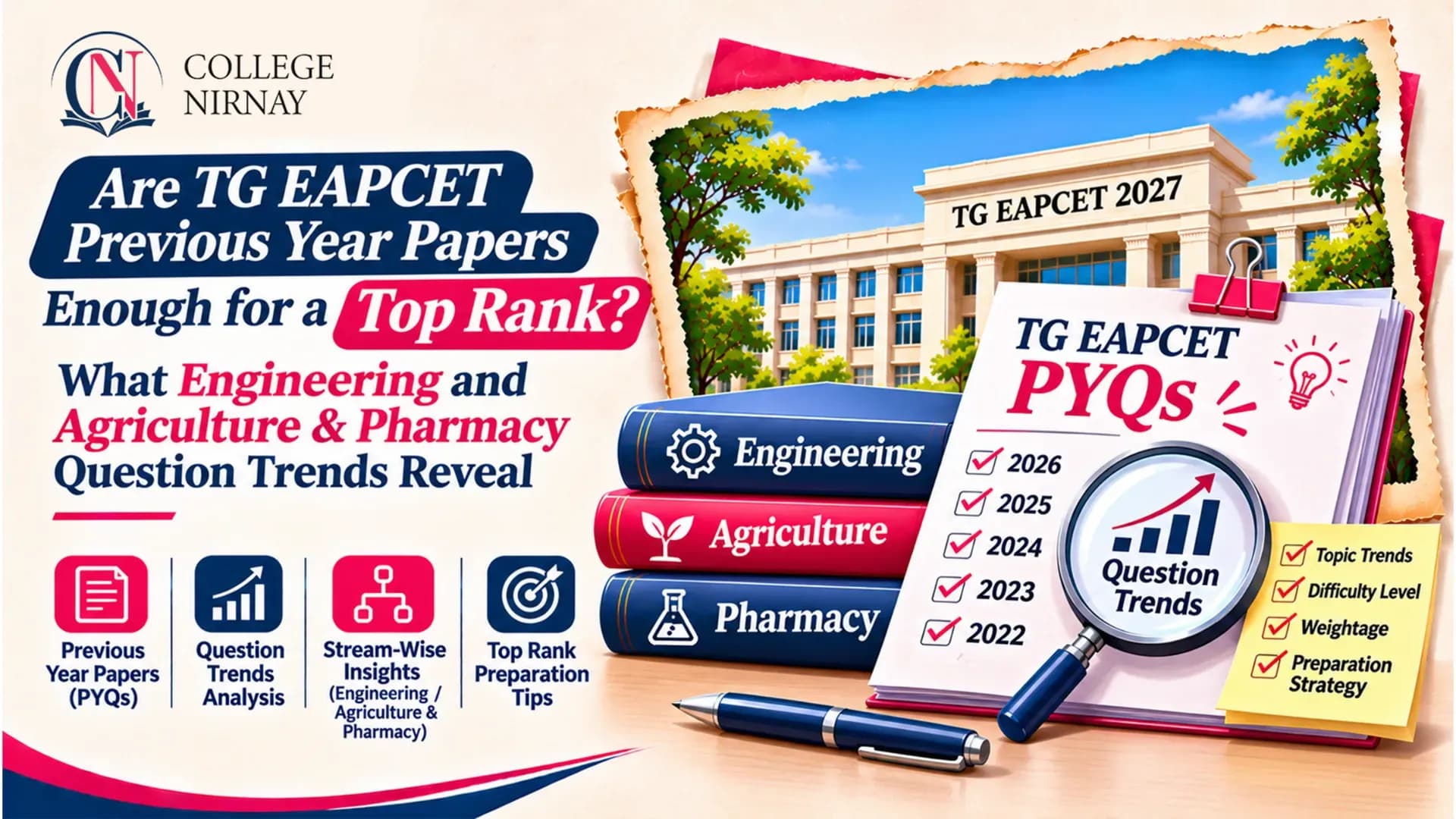
Are TG EAPCET Previous Year Papers Enough for a Top Rank? What Engineering and Agriculture & Pharmacy Question Trends Reveal
Can solving the last five years of TG EAPCET question papers help you secure a top rank, or does a successful preparation strategy require something more? Many Engineering and Agriculture & Pharmacy aspirants believe that repeatedly solving previous examination papers is sufficient to score well. However, recognising familiar questions and being able to solve unfamiliar problems under examination pressure are two different skills.
The TG EAPCET 2027 previous year question papers can help students understand examination structure, subject distribution, question formats, calculation requirements and preparation gaps. Regular practice with TG EAPCET PYQs 2027 can also improve confidence and familiarity with the computer-based examination.
However, an effective TG EAPCET top rank preparation strategy must combine previous-year questions with complete syllabus coverage, conceptual understanding, timed mock examinations and detailed performance analysis.
This guide explains how to conduct a meaningful TG EAPCET previous year paper analysis, understand TG EAPCET Engineering question trends and TG EAPCET Agriculture and Pharmacy question trends, and develop a preparation strategy that goes beyond memorising previously asked questions.
Previous-year papers provide historical preparation references. They do not guarantee that identical questions, chapter-wise distributions or difficulty levels will appear in 2027. Students should follow the final official TG EAPCET 2027 syllabus, examination pattern and marking scheme once published.
What Do TG EAPCET Previous Year Papers Actually Reveal?
Previous-year question papers are records of actual examinations conducted in earlier years. Unlike independently developed practice tests, they allow students to observe real examination formats and the different ways in which prescribed concepts may be tested.
A systematic review of TG EAPCET 2027 previous year question papers should focus on question types, subject-wise difficulty, solving time, conceptual requirements and recurring mistakes rather than simply counting completed papers.
Students preparing through TG EAPCET MPC previous year papers should primarily analyse Mathematics, Physics and Chemistry. Those using TG EAPCET BiPC previous year papers should examine Botany, Zoology, Physics and Chemistry separately.
Previous-Year Examination Pattern: Engineering vs Agriculture & Pharmacy
| Subject | Engineering | Agriculture & Pharmacy |
|---|---|---|
| Mathematics | 80 Questions | Not Applicable |
| Botany | Not Applicable | 40 Questions |
| Zoology | Not Applicable | 40 Questions |
| Physics | 40 Questions | 40 Questions |
| Chemistry | 40 Questions | 40 Questions |
| Total Questions | 160 | 160 |
Reference: TG EAPCET 2026 examination framework. The final 2027 examination pattern must be verified separately.
Five Things Students Can Learn From Previous Year Papers
Question Structure
Understand how numerical problems, conceptual questions, factual recall and application-based questions can be presented.
Concept Recurrence
Identify whether similar formulas, principles or biological processes appear through differently framed questions.
Difficulty Variation
Compare direct questions with questions requiring several calculation steps or connections between multiple concepts.
Time Requirements
Determine which subjects and question categories require additional solving time during a full-length examination.
Personal Preparation Gaps
Identify forgotten formulas, weak chapters, calculation errors, incorrect assumptions and topics requiring further revision.
Where to Begin: Available 2026 Session Papers
| Examination Date | Stream | Available Sessions |
|---|---|---|
| 4 May 2026 | Agriculture & Pharmacy | Morning and Afternoon |
| 5 May 2026 | Agriculture & Pharmacy | Morning |
| 9 May 2026 | Engineering | Morning and Afternoon |
| 10 May 2026 | Engineering | Morning and Afternoon |
| 11 May 2026 | Engineering | Morning and Afternoon |
| Total | Both Streams | 9 Session Papers |
Students can access these papers through available examination archives and compare their performance across different sessions. Always prefer officially released master papers and final answer keys wherever available.
Are Previous Year Papers Alone Enough to Secure a Top Rank?
Previous-year papers are valuable because they allow students to test their knowledge using authentic examination questions. However, their effectiveness depends on how they are used and whether students can apply their learning to unfamiliar problems.
A strong TG EAPCET top rank preparation strategy requires more than remembering answers from previous examinations. Students must develop the ability to recognise relevant concepts even when the numerical values, diagrams, answer options or question wording change.
Depending Only on PYQs
- Builds familiarity with previously asked questions.
- May leave untested syllabus areas uncovered.
- Can encourage memorisation instead of understanding.
- May create inflated scores after repeated attempts.
- Provides limited exposure to unseen questions.
- Does not guarantee a particular examination rank.
Combining PYQs With Complete Preparation
- Develops conceptual understanding across the syllabus.
- Improves confidence with unfamiliar questions.
- Identifies and corrects individual weaknesses.
- Strengthens calculation speed and accuracy.
- Develops examination time-management skills.
- Provides a more reliable measure of readiness.
Why Repeated Concepts Matter More Than Repeated Questions
Students often search for TG EAPCET repeated questions expecting identical problems to return in the examination. While similar concepts may be tested again, neither exact repetition nor a fixed number of repeated questions should be assumed.
Illustrative Example: Same Concept, Different Question
A potential difference of 12 V is applied across a resistance of 4 Ω. Calculate the current.
I = V/R = 12/4 = 3 A
A conductor carries a current of 2 A when connected to a 10 V supply. Calculate its resistance.
R = V/I = 10/2 = 5 Ω
Both questions use Ohm's law, but the required quantity changes. A student who understands the relationship between voltage, current and resistance can solve both questions without memorising individual answers.
The above questions are original illustrative examples, not reproduced TG EAPCET previous-year questions.
How to Build a Balanced Preparation Strategy
This is an illustrative study-time allocation for a balanced preparation phase. Students should adjust the percentages according to their syllabus completion and performance.
The most productive way to use TG EAPCET PYQs 2027 is to identify gaps, correct mistakes and apply previously learned concepts to fresh examination-style questions.
Engineering and Agriculture & Pharmacy: Subject-Wise Question Trends
Understanding the differences between the Engineering examination and the Agriculture & Pharmacy examination is important for identifying appropriate preparation priorities.
A meaningful review of TG EAPCET Engineering question trends should examine Mathematics, Physics and Chemistry individually, while a review of TG EAPCET Agriculture and Pharmacy question trends must also address Botany and Zoology separately.
Students researching TG EAPCET chapter wise weightage 2027 should distinguish between historical subject distribution, independently calculated chapter frequencies and unverified future predictions.
Engineering Subject Distribution
Agriculture & Pharmacy Subject Distribution
Both charts represent the 2026 examination structure and not confirmed 2027 chapter-wise weightage.
Mathematics Question Analysis
Students solving TG EAPCET Mathematics previous year papers should examine calculation length, formula application, algebraic manipulation and the time required to recognise suitable solving methods.
Mathematics represented half of the Engineering paper in 2026, making consistent practice particularly important for Engineering aspirants.
| Chapter Group | Question Types to Track | Preparation Skill |
|---|---|---|
| Algebra and Matrices | Equations, determinants and transformations | Algebraic accuracy |
| Trigonometry | Identities, equations and applications | Formula recognition |
| Coordinate Geometry | Straight lines, circles and conic sections | Visualisation and equations |
| Calculus | Limits, differentiation and integration | Method selection |
| Vector Algebra | Vector products and spatial relationships | Direction and calculation |
| Probability and Combinatorics | Counting, arrangements and probability | Logical interpretation |
Instead of solving only familiar Mathematics problems, practise variations that change the given information or require an alternative solving method.
Physics Question Analysis
The TG EAPCET Physics previous year papers can be used to evaluate formula selection, conceptual reasoning, numerical calculation and unit accuracy.
| Chapter Group | Question Types to Track | Preparation Skill |
|---|---|---|
| Mechanics | Motion, force, energy and rotation | Problem interpretation |
| Thermal Physics | Heat, temperature and thermodynamic processes | Conceptual relationships |
| Electricity | Electric fields, circuits and capacitance | Formula application |
| Magnetism | Magnetic forces and electromagnetic induction | Direction-based reasoning |
| Optics and Waves | Reflection, refraction and wave relationships | Diagram interpretation |
| Modern Physics | Atoms, nuclei and electronic devices | Conceptual and factual accuracy |
Record whether each incorrect Physics answer resulted from misunderstanding the question, selecting the wrong formula, making an arithmetic error or forgetting a concept.
Chemistry Question Analysis
Effective practice with TG EAPCET Chemistry previous year papers requires students to classify questions into Physical, Organic and Inorganic Chemistry.
Physical Chemistry
- Stoichiometry
- Thermodynamics
- Chemical Equilibrium
- Solutions
- Electrochemistry
- Chemical Kinetics
Focus: Numerical accuracy, formulas and units.
Organic Chemistry
- General Organic Chemistry
- Hydrocarbons
- Alcohols and Phenols
- Carbonyl Compounds
- Carboxylic Acids
- Amines
Focus: Reaction mechanisms, products and conversions.
Inorganic Chemistry
- Atomic Structure
- Periodic Properties
- Chemical Bonding
- Block Elements
- Coordination Compounds
- Element Properties
Focus: Textbook facts, properties and conceptual relationships.
Botany Question Analysis
Students practising TG EAPCET Botany previous year papers should analyse classification questions, biological terminology, plant processes, diagrams and conceptual relationships.
| Chapter Group | Revision Focus |
|---|---|
| Plant Diversity | Classification, characteristics and examples |
| Morphology and Anatomy | Plant structures, tissues and functions |
| Cell Biology | Organelles, biomolecules and cell division |
| Plant Physiology | Photosynthesis, respiration and transport |
| Genetics and Molecular Biology | Inheritance, DNA and gene expression |
| Biotechnology | Techniques, terminology and applications |
Botany preparation should include repeated textbook revision and active recall rather than memorising previous answer options in isolation.
Zoology Question Analysis
The TG EAPCET Zoology previous year papers help students practise human physiology questions, animal classification, reproductive biology, genetics and other syllabus-based concepts.
| Chapter Group | Revision Focus |
|---|---|
| Animal Diversity | Classification, distinguishing features and examples |
| Structural Organisation | Animal tissues and biological structures |
| Human Physiology | Digestion, circulation, respiration and excretion |
| Neural and Hormonal Coordination | Control mechanisms and hormone functions |
| Human Reproduction | Reproductive structures and processes |
| Genetics and Evolution | Inheritance patterns and evolutionary concepts |
Students should practise distinguishing between closely related biological terms and understanding the sequence of physiological processes.
The chapter groups listed above are suggested areas for syllabus-based practice and paper classification. They are not measured historical frequency rankings or confirmed TG EAPCET important topics 2027. Students should verify their inclusion in the final 2027 syllabus.
How to Calculate Historical Chapter-Wise Weightage
Instead of relying on unsupported lists of TG EAPCET high scoring chapters, students can calculate historical question frequency using a collection of previous examination papers.
- Select multiple complete papers from the same examination stream.
- Separate the questions according to subject.
- Assign each question to its primary syllabus chapter.
- Count chapter appearances across all selected papers.
- Calculate the chapter's share of total subject questions.
- Compare historical frequency with personal test accuracy.
- Check whether the chapter remains included in the latest syllabus.
Historical Chapter Share Formula
For example, if a chapter accounts for 18 questions out of 240 Mathematics questions across three practice papers, its historical share in that sample is 7.5%.
Such a calculation can help students researching TG EAPCET chapter wise weightage 2027 understand historical patterns without incorrectly treating them as future examination guarantees.
Understanding Question Paper Difficulty
The TG EAPCET question paper difficulty level may be experienced differently by students depending on their preparation, question selection, calculation speed and familiarity with the concepts being tested.
| Question Category | Typical Characteristics | Suggested Approach |
|---|---|---|
| Direct | Recall or straightforward formula application | Attempt during the first round. |
| Moderate | Requires several steps or concept interpretation | Attempt when sufficient time is available. |
| Time-Consuming | Lengthy calculations or complex reasoning | Mark for review and revisit strategically. |
The 2026 examination used a normalization procedure to account for potential differences across sessions. Students should therefore avoid assuming that an identical raw score in two different shifts necessarily corresponds to the same normalized performance or rank.
How to Use Previous Year Papers for TG EAPCET Rank Improvement
An effective TG EAPCET 2027 rank improvement strategy should measure improvements in accuracy, syllabus coverage, speed and the ability to answer unfamiliar questions.
The purpose of a detailed TG EAPCET previous year paper analysis is not merely to record marks. It is to identify exactly why marks were lost and what preparation changes can prevent similar mistakes in future examinations.
Six-Step Previous Year Paper Analysis Method
Attempt an Unseen Paper
Select a complete paper that you have not previously solved. Attempt it without textbooks, formula sheets or visible answer keys.
Simulate Examination Conditions
Use a 180-minute timer when practising under the previous examination pattern. Avoid unnecessary interruptions and practise using a computer-based test interface when available.
Calculate Subject-Wise Scores
Use a reliable answer key to record correct, incorrect and unattempted questions for each subject. Prefer final answer keys when available.
Classify Every Mistake
Determine whether each lost mark resulted from a conceptual weakness, forgotten formula, calculation error, misreading, time shortage or incorrect guess.
Revise the Underlying Concepts
Return to the relevant chapter, review the correct solution and practise fresh questions based on the same underlying concept.
Retest Using a Different Paper
Attempt another unseen paper after targeted revision. Compare performance using similar testing conditions rather than relying on improved scores from memorised questions.
Three Performance Metrics Every Aspirant Should Track
Accuracy Rate
(Correct ÷ Attempted) × 100
Measures the percentage of attempted questions answered correctly.
Attempt Rate
(Attempted ÷ Total) × 100
Measures how much of the available paper was attempted.
Correct Coverage
(Correct ÷ Total) × 100
Measures correct answers as a percentage of all available questions.
Accuracy is undefined when no questions have been attempted. Record it as not applicable rather than assigning a misleading percentage.
Engineering Case Study: Identifying Hidden Scoring Opportunities
Consider an Engineering aspirant who attempts a complete previous-year paper under timed conditions and obtains the following illustrative results.
| Subject | Total | Attempted | Correct | Incorrect | Skipped | Accuracy |
|---|---|---|---|---|---|---|
| Mathematics | 80 | 70 | 49 | 21 | 10 | 70% |
| Physics | 40 | 35 | 21 | 14 | 5 | 60% |
| Chemistry | 40 | 40 | 32 | 8 | 0 | 80% |
| Total | 160 | 145 | 102 | 43 | 15 | 70.34% |
Subject-Wise Accuracy Comparison
What Should This Engineering Student Improve?
- Physics has the lowest attempted-question accuracy and requires targeted conceptual revision.
- Mathematics has the largest absolute number of missed marks, making it another major scoring opportunity.
- Chemistry is relatively stronger but still contains eight incorrect answers requiring review.
- The 15 skipped questions should be analysed for time-management problems or syllabus gaps.
- Correct answers obtained through guessing should be reviewed before considering those concepts mastered.
Agriculture & Pharmacy Case Study: Why Biology Alone May Not Be Enough
A BiPC student may perform well in Botany and Zoology but lose valuable marks in Physics and Chemistry. Since each subject contributed 40 questions in the previous Agriculture & Pharmacy pattern, ignoring either science subject can significantly restrict overall performance.
| Subject | Total | Attempted | Correct | Incorrect | Skipped | Accuracy |
|---|---|---|---|---|---|---|
| Botany | 40 | 40 | 34 | 6 | 0 | 85% |
| Zoology | 40 | 40 | 36 | 4 | 0 | 90% |
| Physics | 40 | 30 | 18 | 12 | 10 | 60% |
| Chemistry | 40 | 35 | 24 | 11 | 5 | 68.57% |
| Total | 160 | 145 | 112 | 33 | 15 | 77.24% |
This student has already answered 70 out of 80 Biology questions correctly but only 42 out of 80 Physics and Chemistry questions correctly. Additional Physics and Chemistry revision could provide greater room for improvement while the student maintains Biology performance.
Both case studies use invented practice-test data to demonstrate performance analysis. They do not represent actual candidates, official examination results or predicted ranks.
Suggested 180-Minute Mock Test Strategy
A practical TG EAPCET mock test strategy should reproduce the examination duration, encourage intelligent question selection and reserve sufficient time for reviewing marked questions.
| Activity | Engineering | Agriculture & Pharmacy |
|---|---|---|
| Mathematics | 90 Minutes | Not Applicable |
| Botany | Not Applicable | 40 Minutes |
| Zoology | Not Applicable | 40 Minutes |
| Physics | 40 Minutes | 45 Minutes |
| Chemistry | 35 Minutes | 40 Minutes |
| Final Review | 15 Minutes | 15 Minutes |
| Total Duration | 180 Minutes | 180 Minutes |
These are suggested personal time allocations, not official subject-wise time limits.
Average Available Time per Question
180 Minutes × 60 Seconds ÷ 160 Questions
This is an overall average before reserving review time. Individual questions may require substantially more or less time.
What If There Is No Negative Marking in 2027?
The previous examination pattern awarded one mark for a correct answer and did not deduct marks for incorrect answers. If the same marking rules continue in 2027, students can consider attempting remaining unanswered questions after completing their confident answers.
However, blindly guessing early in the examination may waste valuable time that could otherwise be used to solve questions accurately. Confirm the final 2027 marking scheme before applying this strategy.
Maintain a Personal PYQ Error Notebook
| Subject | Chapter | Mistake Type | Corrective Action | Retest |
|---|---|---|---|---|
| Mathematics | Integration | Incorrect method | Revise substitution and integration by parts | After 2 Days |
| Physics | Current Electricity | Formula selection | Practise circuit-based questions | After 2 Days |
| Chemistry | Organic Chemistry | Reaction recall | Create a reaction revision chart | After 3 Days |
| Botany | Plant Physiology | Process confusion | Revise process diagrams and comparisons | After 2 Days |
| Zoology | Human Physiology | Incorrect factual recall | Revise textbook facts and organ functions | After 3 Days |
Four-Week PYQ-Based Revision Roadmap
Diagnostic Assessment
- Attempt one complete unseen paper.
- Identify weak subjects.
- Record recurring error types.
- Prepare a chapter-priority list.
Targeted Improvement
- Revise weak chapters.
- Practise chapter-wise PYQs.
- Attempt fresh question variations.
- Strengthen formula and fact recall.
Timed Mixed Practice
- Attempt mixed-year question sets.
- Take timed subject tests.
- Improve question-selection skills.
- Analyse speed and accuracy together.
Final Readiness Check
- Attempt unseen full-length mocks.
- Review the personal error notebook.
- Revise difficult formulas and diagrams.
- Measure remaining preparation gaps.
The four-week plan is most suitable as a structured revision phase after substantial syllabus completion. Students with significant syllabus gaps should allow additional time for concept development.
Suggested Daily PYQ Practice Schedule
| Study Activity | Duration | Objective |
|---|---|---|
| Concept Revision | 90 Minutes | Strengthen fundamentals |
| Chapter-Wise PYQs | 90 Minutes | Practise actual examination questions |
| Fresh MCQs | 60 Minutes | Test application to unfamiliar problems |
| Timed Subject Test | 60 Minutes | Improve examination speed |
| Error Analysis | 40 Minutes | Correct weak concepts and mistakes |
| Formula and Fact Recall | 20 Minutes | Improve long-term retention |
| Total Study Time | 360 Minutes | 6 Hours Excluding Breaks |
Students can adapt this schedule according to school commitments, Intermediate board examinations, coaching classes and individual learning requirements. Full-length mock-test days should follow a separate schedule that includes sufficient post-test analysis.
Common Mistakes Students Make While Solving TG EAPCET PYQs
Completing a large number of previous-year papers does not automatically translate into better examination performance. Students may repeatedly practise questions while continuing to make the same conceptual, calculation and time-management mistakes.
| Common Mistake | Why It Reduces Preparation Quality | Better Approach |
|---|---|---|
| Memorising Answers | Does not develop independent problem-solving ability. | Understand concepts and solve variations. |
| Solving Only Recent Papers | Limits exposure to different question formulations. | Include several relevant years and shifts. |
| Ignoring the Latest Syllabus | May result in unnecessary practice or missed topics. | Check the current official syllabus. |
| Practising Without a Timer | Does not measure examination readiness accurately. | Use timed tests regularly. |
| Skipping Difficult Chapters | Creates avoidable syllabus gaps. | Learn fundamentals before advanced practice. |
| Ignoring Incorrect Answers | Allows the same mistakes to recur. | Maintain a detailed error notebook. |
| Reviewing Only Wrong Questions | Overlooks correct answers obtained through guessing. | Review low-confidence correct answers too. |
| Trusting Every Unofficial Answer Key | Can reinforce incorrect solutions. | Prefer official final keys. |
| Comparing Different Shifts by Raw Marks Alone | Ignores difficulty variation and normalization. | Use raw scores for personal practice tracking, not guaranteed rank prediction. |
| Neglecting Unseen Questions | May create a false impression of mastery. | Combine PYQs with fresh mock examinations. |
| Focusing Only on Favourite Subjects | Leaves significant scoring opportunities unused. | Allocate time according to performance gaps. |
| Expecting Exact Question Repetition | Creates dependence on unpredictable examination content. | Prepare complete syllabus-based concepts. |
How to Identify Personally High-Scoring Chapters
The most useful TG EAPCET high scoring chapters for an individual student are not necessarily the chapters described as easiest in examination preparation guides.
A chapter may provide strong scoring opportunities when the student understands its concepts, solves questions accurately and can complete unfamiliar problems within a reasonable time.
High Revision Priority
Chapters with weak understanding, low accuracy or recurring mistakes that also appear in relevant historical question sets.
Scoring Maintenance
Chapters with high accuracy and reliable solving speed that require periodic revision to prevent knowledge loss.
Uncovered Syllabus
Chapters not yet studied or insufficiently tested, regardless of how frequently they appeared in the selected historical papers.
Final PYQ Preparation Checklist
Frequently Asked Questions About TG EAPCET Previous Year Papers
1. Are previous-year question papers enough to secure a top rank in TG EAPCET 2027?
Previous-year papers are valuable but cannot guarantee a top rank independently. Students should combine PYQ practice with conceptual preparation, complete syllabus coverage, fresh mock tests and regular error analysis.
2. How many years of TG EAPCET question papers should I solve?
Practising papers from the most recent three to five years can provide a useful starting point. Students should include multiple shifts and verify that older questions remain relevant to the current syllabus.
3. Does TG EAPCET repeat questions from previous examinations?
Similar concepts may appear through different question formats. However, students searching for TG EAPCET repeated questions should not assume that identical questions will necessarily appear in the next examination.
4. Which subject is most important for Engineering aspirants?
Mathematics accounted for 80 out of 160 questions in 2026. Engineering aspirants should therefore practise TG EAPCET Mathematics previous year papers regularly while maintaining Physics and Chemistry preparation.
5. Can BiPC students focus only on Botany and Zoology?
No. Botany and Zoology together contributed 80 questions in the previous examination pattern, while Physics and Chemistry contributed the remaining 80 questions. All four subjects require consistent preparation.
6. How should Engineering students use MPC previous-year papers?
Students should solve TG EAPCET MPC previous year papers under timed conditions, evaluate Mathematics, Physics and Chemistry separately, and concentrate on improving weak chapters and calculation speed.
7. How should Agriculture and Pharmacy aspirants use BiPC papers?
Students using TG EAPCET BiPC previous year papers should analyse Botany, Zoology, Physics and Chemistry individually. Strong Biology scores should not be used as a reason to neglect the other subjects.
8. How can previous papers improve Physics preparation?
TG EAPCET Physics previous year papers help students practise conceptual questions, formula selection, numerical calculations and unit conversion. Incorrect answers should be reviewed chapter-wise.
9. What is the best way to analyse Chemistry PYQs?
Classify TG EAPCET Chemistry previous year papers into Physical, Organic and Inorganic Chemistry questions. Record whether mistakes arise from calculations, reaction recall, conceptual understanding or textbook facts.
10. How can I improve Botany marks using previous-year questions?
Use TG EAPCET Botany previous year papers to identify gaps in classification, plant structures, physiology, genetics and biotechnology preparation. Combine question practice with textbook-based active recall.
11. How should I practise Zoology previous-year questions?
TG EAPCET Zoology previous year papers should be used to revise animal diversity, human physiology, reproduction, inheritance and other prescribed topics. Practise diagrams and biological process sequences where relevant.
12. Can previous papers reveal the exact difficulty level of TG EAPCET 2027?
No. The TG EAPCET question paper difficulty level for 2027 cannot be known in advance. Previous papers provide historical examples of question formats, calculation requirements and variation across examination sessions.
13. How can I identify important chapters for TG EAPCET 2027?
Identify TG EAPCET important topics 2027 through the official syllabus, historical paper classification and your personal test results. Avoid treating predicted chapter lists as guaranteed examination distributions.
14. Should I solve previous-year papers with or without a timer?
Untimed practice is useful during concept learning. Timed full-length practice should also form part of the TG EAPCET mock test strategy to evaluate speed, accuracy and examination readiness.
15. Is attempting every question necessary for a good score?
Students should prioritise accurate answers. If the absence of negative marking continues in 2027, attempting remaining unanswered questions may be beneficial after confident questions have been completed. Verify the official marking scheme first.
16. Should I solve the same previous-year paper multiple times?
Reattempting incorrect questions is useful for revision. However, repeated full-paper scores may be inflated by familiarity with answers, so unseen papers are more useful for evaluating current examination readiness.
17. Can a previous-year paper score predict my exact TG EAPCET rank?
No. Final ranks depend on official ranking rules, normalization where applicable and the performance of other candidates. Practice-paper marks are useful for tracking preparation but cannot guarantee a particular rank.
18. When should I begin solving full-length previous-year papers?
Students can begin with chapter-wise PYQs during syllabus preparation. Full-length papers become increasingly useful once substantial syllabus coverage has been achieved.
19. Can old TS EAMCET papers be used for TG EAPCET preparation?
Yes. Earlier Telangana examination papers published under the TS EAMCET name can provide useful practice, provided students verify their relevance to the current syllabus and examination pattern.
20. Where can I find TG EAPCET previous-year question papers?
Students can refer to the official TG EAPCET examination website, archived master question papers and reliable educational resources. College Nirnay also provides examination-related guidance and previous-year question paper information.
Final Verdict: Previous Year Papers Are a Preparation Tool, Not a Complete Preparation Strategy
Previous-year question papers remain one of the most valuable resources for understanding the TG EAPCET examination format and evaluating individual preparation levels. They help students recognise question structures, practise relevant concepts and identify subjects requiring additional attention.
Engineering aspirants should maintain strong Mathematics preparation alongside Physics and Chemistry, while Agriculture & Pharmacy aspirants should develop balanced performance across Botany, Zoology, Physics and Chemistry.
An effective TG EAPCET 2027 rank improvement strategy should combine historical question practice, complete syllabus coverage, fresh MCQs, timed mock examinations and detailed error correction.
Ultimately, the objective is not to memorise hundreds of previously asked questions. It is to develop the ability to answer unfamiliar questions accurately within the available examination time. Students who use previous papers to strengthen concepts rather than merely recognise answers can build a more reliable foundation for competitive examination performance.
Examination References and Useful Preparation Resources
- Official TG EAPCET Examination Website
- TG EAPCET 2026 Session-Wise Question Paper Archive
- TG EAPCET Historical Question Paper Archive
- Importance of TG EAPCET Previous Year Papers
- TG EAPCET Chapter-Wise Weightage and Question Analysis
- How to Use TG EAPCET Previous-Year Questions
- Common PYQ Preparation Mistakes
- TG EAPCET Previous Year Papers FAQs
- TG EAPCET Syllabus and Subject-Wise Topics
- TG EAPCET Exam Pattern and Marking Scheme
Historical examination papers and information booklets should be used as preparation references. The final TG EAPCET 2027 official notification, information booklet and syllabus will take precedence over previous examination documents. The practice scores, chapter examples and study schedules used in this article are illustrative recommendations.
Practise Smarter. Improve Accuracy. Prepare for TG EAPCET 2027.
Explore previous-year question papers, detailed syllabus information, examination patterns, eligibility requirements and preparation resources on College Nirnay.
Explore TG EAPCET Previous Year Papers